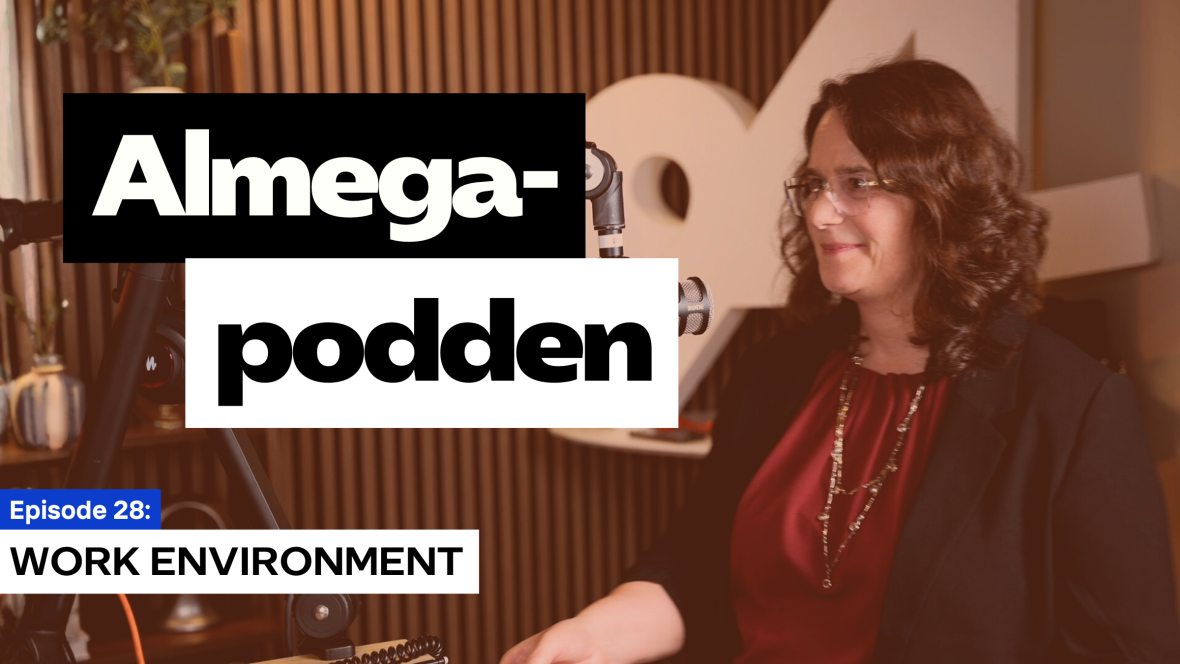
Podcast: Work environment – the entire episode transcribed
In episode 28 of Almegapodden we break down the essentials of the Swedish work environment regulations for our English-speaking audience. What they mean, why they matter and how they shape everyday working life. Below is a transcript of the entire episode.
Ann Hallsenius
A warm welcome to Almega´s podcast. We hope that this podcast will provide you with quick insights and that we can clarify what can be done in various labor law issues so that it becomes easy for you to follow Swedish rules and regulations. Today we’re exploring the essentials of the Swedish work environment regulation. What they mean, why they matter and how they shape everyday working life. My name is Anne Hallsenius and by my side I have two Almigas, experts on labor law. Lyna and Kristin.
Lina Cronebäck
Yes, I’m Lina Cronebäck. I work as a labor lawyer and a litigation specialist.
Christine Sorselius
And my name is Christine Sorselius and I work as a labour law expert and negotiator. I give day to day advice to our member companies and negotiate collective bargaining agreements as well as.
Ann Hallsenius
Very welcome to today’s episode and very welcome to you listeners. We start off with talking about the basics. Lina, work environment is well cared for in the Swedish law. The lawmakers have made a point of the fact that employers have to make sure that the work environment is sound for employees. How can we understand this?
Lina Cronebäck
Well, the work environment legislation in Sweden is all about prevention and well being. The cornerstone is the Work Environment act, which sets out that every employer must create a safe, a healthy and an inclusive workplace. And this is a framework law. It focuses on prevention, collaboration and adapting work to the specific individual.
Ann Hallsenius
So there is a framework?
Lina Cronebäck
There is a framework, but it doesn’t stop there. There are also work environment provisions issued by the Work Environment Authority and they add more detail. They’re covering everything from ergonomics and chemicals to organizational social factors.
Ann Hallsenius
You mentioned the authority. Sweden has quite a large governmental agency to administer work environment issues. Why do we have such strong regulations? Is there a specific historic reason or.
Lina Cronebäck
I think that Swedish employers have long recognized the benefits of low sick leave rates of long term productivity and strong employer reputation. And therefore employers have accepted a relatively strong regulatory framework.
Ann Hallsenius
Interesting. Some of you may know a little about the Swedish work environment system. You have probably heard that the employer is responsible and that the work must be systematic. Christine, could you tell us a little bit more about that?
Christine Sorselius
Yes, that’s correct. The work environment efforts must be carried out systematically to ensure effectiveness and that nothing falls through the cracks. And there is a key concept called the systematic work environment management. In Swedish it’s Systematiskt Arbetsmiljöarbete, also called SAM. This is a structured, ongoing process that follows four steps in which the employer must follow. First, the employer needs to investigate to identify potential risks, then to assess those risks and to take action to eliminate or reduce risks. And lastly to follow up to make sure the measures are working. This cycle is about continuous improvement and should be integrated into daily routines and meetings and annual reviews. And this is both the employer and the employees who are involved, and the safety representatives also play a crucial role in this process.
Ann Hallsenius
So there are several parts involved and a lot of steps. Who does what, Lina?
Lina Cronebäck
Well, the employer has the main responsibility for the work environment. That means taking all necessary measures to prevent accidents and ill health and adapting the work environment to the individual and also reporting incidents to the authorities. But employees also have duties. They must follow the safety rules and use protective equipment, for example. But then, as Christine mentioned, we also have the safety representatives and they’re often appointed by the unions. But they represent all employees in matters that concern work environment, and they should participate in the ongoing systematic process alongside the employer. But they also have specific rights to request action from the employer. And in very urgent cases they can stop dangerous work immediately.
Ann Hallsenius
So they have some serious power.
Lina Cronebäck
Yes, they really do. And this is a very serious matter.
Ann Hallsenius
Yes, you’re right about that. So we talked about the physical work environment. Are there any other aspects?
Lina Cronebäck
It’s not only about physical safety. It also includes organizational and social work environment, which is just as important. And employers must prevent unhealthy workloads, as well as making sure working hours are organized in a way that prevents ill health and promotes a sustainable working environment.
Ann Hallsenius
So you’re really telling me that the mental health and social dynamics are just as critical as the physical safety?
Lina Cronebäck
Yeah, it’s just as important for the employer to work with those areas as well.
Ann Hallsenius
For example, preventing harassment in the workplace. Is that also regulated?
Christine Sorselius
Well, a healthy workplace is free from harassment, victimization and bullying and other such behavior. Employers must establish clear policies that communicate zero tolerance for such behavior. And these policies must be communicated to all employees. There must also be procedures in place when incidents are reported.
Ann Hallsenius
Of course, all of this is quite a lot to take in, I imagine, even if you’re a Swedish employer more used to Swedish regulations, do you get a lot of questions from employers?
Christine Sorselius
Yes, we do. We do receive a lot of questions about these procedures. And we are here to help and guide our member companies in these difficult questions. And we also offer courses in English on this topic and others upon request.
Ann Hallsenius
So in that case, the employer needs to contact you, for instance. Or is it.
Christine Sorselius
Yes, they contact us and we give an offer. Any topic, actually, but this specifically as well.
Ann Hallsenius
That sounds good. I think we have at least browsed the subject of work environment regulations. So Lina, could you help me sum up or give some closing remarks?
Lina Cronebäck
Yeah, sure. Well, to sum up, this legislation is about prevention. The employer needs to make sure that they have a systematic way of identifying and assessing risks in the workplace in order to take measures before something actually happens. And this needs to be an ongoing work and everyone has a role to play in creating a safe, healthy and inclusive workplace.
Ann Hallsenius
Such important work. Thank you both again for participating in the podcast. This actually wraps up today’s episode of Almegapodden. We hope that this gave you listeners some understanding of your rights and responsibilities when it comes to Swedish work environment regulations. If you found this helpful, please subscribe to the podcast and share Almegapodden with your colleagues. As always, we advise members to look for more information with Almega’s digital service Arbetsgivarguiden, where you can find information checklists and other useful tools as well as online courses that you mentioned, Christine, by our excellent counselors. We also invite you to visit almega.se, where you can find information on Almega and its associated organizations and if you’re not a member, how to become one. We hope that you will listen in on more of our podcasts in the Almegapodden series. You will find them where podcasts are found. Almegapodden is mostly in Swedish, but we are producing more and more podcasts in English. So thank you Lina and Christine very much for sharing your expertise today and thank you listeners for listening.
Lina Cronebäck
Thank you, thank you.