Ny rapport: Unshackling EU growth
Rapporten visar att EU:s inre marknad för tjänster halkar efter varumarknaden på grund av överreglering och byråkrati, med över 5 700 reglerade yrken kvar. Författaren föreslår en ”big bang-reform” där tjänster som godkänts i ett EU-land automatiskt ska godkännas i alla, för att öka tillväxten och konkurrenskraften.
- Abstract
- 1) Introduction: All inertia on the deregulation front
- 2) How have the regulated professions in the EU evolved?
- 3) OECD Service Trade Restrictiveness Index
- 4) Making it easier for entrepreneurs? The EU Points of Single Contact
- 5) An agenda for reform
- 6) Conclusions
- Appendix A. Quality scores for countries’ web pages on regulated professions 2025.
- Appendix B. Country recommendations. Explanatory notes to country tables.
- Bibliography
- Referenslista
This report presents evidence on the prevalence of regulatory barriers to trade in services across EU countries. Europe’s Single Market for services has consistently underperformed relative to the Single Market for goods. While home bias and cultural preferences likely affect demand for cross-border trade in services more than goods, the main explanations stem from massive red tape and over-regulation.
In many cases, information requirements are also inaccessible. The EU Single Point of Contact is supposed to help businesses navigate requirements, but almost half the EU member states are judged to have poor websites. Moreover, the so-called regulated professions remain at about 5,700 in 2025, essentially unchanged from two years earlier; concerning the business environment, the OECD service trade restrictiveness indices for the European Economic Area highlight numerous low-hanging fruits, notably in sectors with both high levels of restrictions and high dispersion, such as accounting, legal services, and rail freight transport.
All these obstacles raise two central questions: 1) why are particular professions still subject to regulation, and 2) what motivates the persistence of obstacles to trade in services? This paper argues that many – if not most – of the possible arguments will crumble under scrutiny, and that with the prospect of further disruption in global trade stemming from President Trump and anaemic growth in the EU, policymakers should seize the opportunity to implement reforms to the Single Market.
It is time to consider a “big bang” reform, similar to the principle of mutual recognition in place for trade in goods, to also apply as a general rule for services: if a service is approved in one EU country, it should also be approved in all other countries. Specifically, this should entail removing at least all non-medical regulated professions and retaining only those with majority support among member states. Such reform would bring at least two benefits.
First, it would create more opportunities to absorb workers displaced or affected by AI. Second, deregulation would provide the main antidote to US protectionism, with productivity gains following in the years ahead. T
he alternative to deregulation is further EU stagnation and loss of competitiveness, eroding the foundation for social welfare.
Keywords: Single Market, competitiveness, trade obstacles, red tape, regulated professions.
Mårten Blix1, Charman of Almega FutureTech
2025-09-29
Europe has a growth and competitiveness problem. This was highlighted in two high-level reports published separately in 2024 by former Italian prime ministers Enrico Letta and Mario Draghi.2 Both underscore Europe’s sluggish growth compared with that of the United States. The US has not only achieved higher productivity growth but has proved more resilient, notably in recovering from the aftermath of the financial crisis of 2007–9. Draghi succinctly formulates the seriousness of the challenge: “[w]e have reached the point where, without action, we will have to either compromise our welfare, our environment or our freedom.”3
The EU Single Market for Services is the area where lofty rhetoric has been most at odds with the crass reality of red tape.
This report focuses on the challenges confronting the EU Single Market for services and underlines the urgent need for major, rather than piecemeal, reform. This is not to say that other areas, such as financial market reform, are unimportant – far from it. But the Single Market for services is the area where the lofty rhetoric of goals and ambitions has been most at odds with the crass reality of red tape and bureaucracy facing European businesses.
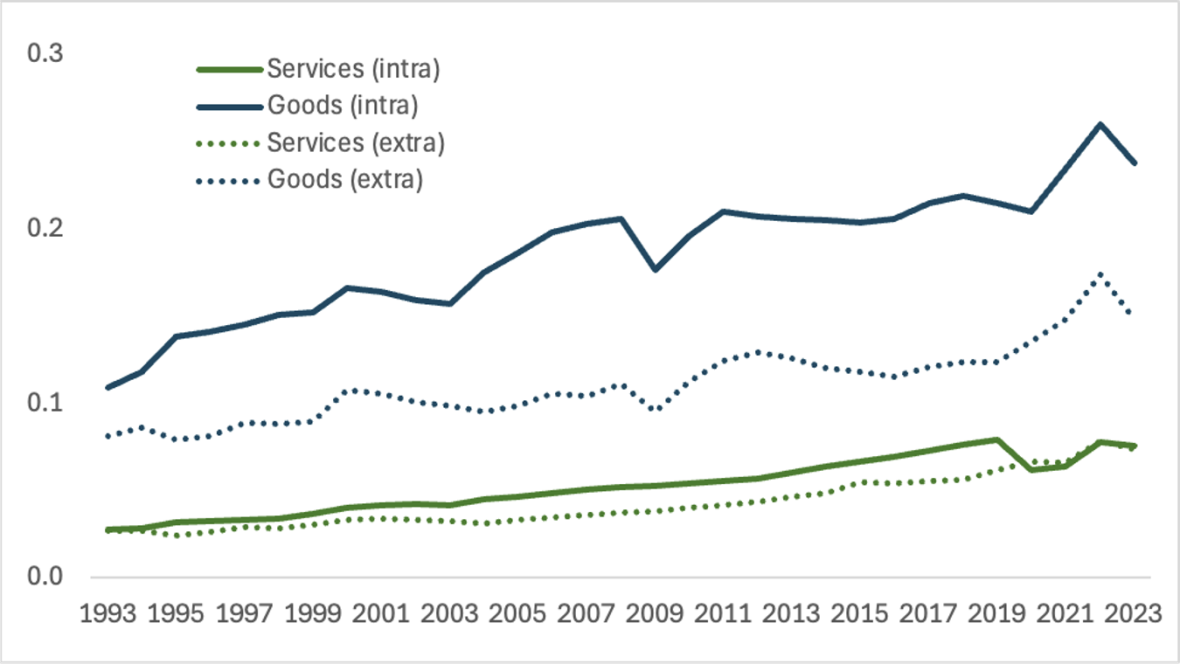
The statistics could not be clearer. As Figure 1 shows, trade in goods has increased steadily since the inception of the Single Market. Moreover, the gap between trade in goods within the EU and trade with non-EU countries has widened, as would be expected if obstacles to intra-EU trade in goods were reduced. The same cannot be said of trade in services. Intra-EU trade in services has grown at a snail’s pace and remains at the same level as trade in services with countries outside the EU – a subpar performance compared with goods. The most likely explanation is the red tape and bureaucracy that remain despite long-standing ambitions to streamline and harmonise. According to IMF estimates, obstacles in the Single Market are equivalent to tariff costs of 44 per cent for goods, but a staggering 110 per cent for services.4
Figure 1. Trade as a share of EU GDP within the Single Market (intra) and with the rest of the world (extra). 1993–2023.
Professions that are regulated in one country only reflect an extreme form of anachronistic protectionism.
This report will highlight some of the most flagrant regulatory hurdles behind these statistics. A striking example: in Slovenia, the profession of wine taster is regulated – but not in the more established wine-producing countries such as France, Germany, Spain, or Italy. In fact, there are 138 professions regulated in one country only, most of them reflecting a similar form of extreme anachronistic protectionism. Why, for example, should ownership of a dance school in Austria be subject to restrictions?
The paper is organized to serve both as an academic report as well as a to-do list for EU member states. Section 2 analyses the current state of play for the regulated professions; Section 3 uses the OECD Intra European Economic Area Services Trade Restrictiveness Index (intra-EEA STRI) to identify and prioritize areas where regulatory reform is most urgent. Section 4 discusses some aspects of how the European Commission seeks to sumarise useful information about trade in services. The penultimate section sketches an agenda for possible reform, and the final section concludes.
While general conclusions are presented in the main body of the paper, the appendix contains more specific information about each member state. The appendix can be read as reference or benchmarking exercise. Alternatively, it could form the basis for peer-to-peer discussions at the political level about which areas of deregulation would yield the most bang for the euro.
Regulated professions in 2025
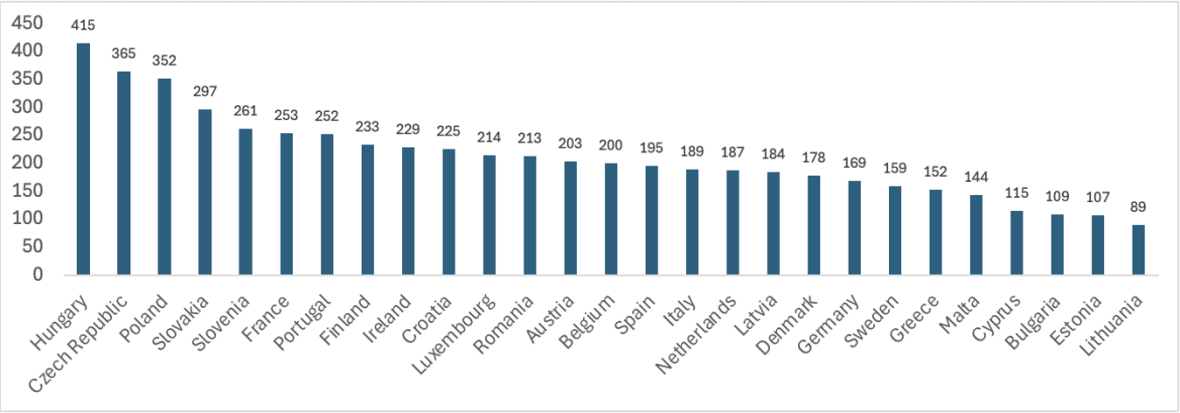
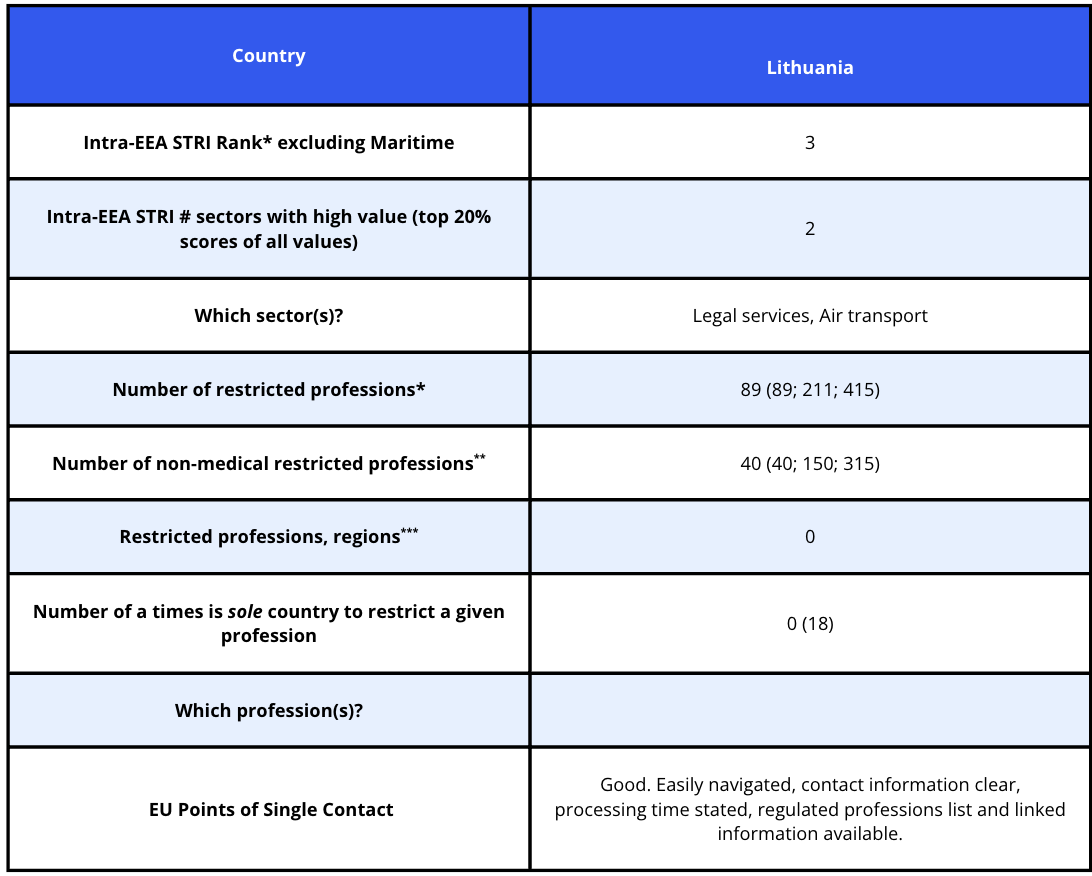
EU member states (MS) impose specific requirements on service professionals wishing to work in their country. Each state has the prerogative to decide which professions are included and what the requirements are. As Figure 2 shows, Hungary has more than 400 such professions, almost five times as many as Lithuania, the country with the fewest. The median number of regulated professions is about 200.
Figure 2. Number of restricted professions in the EU, 2025.
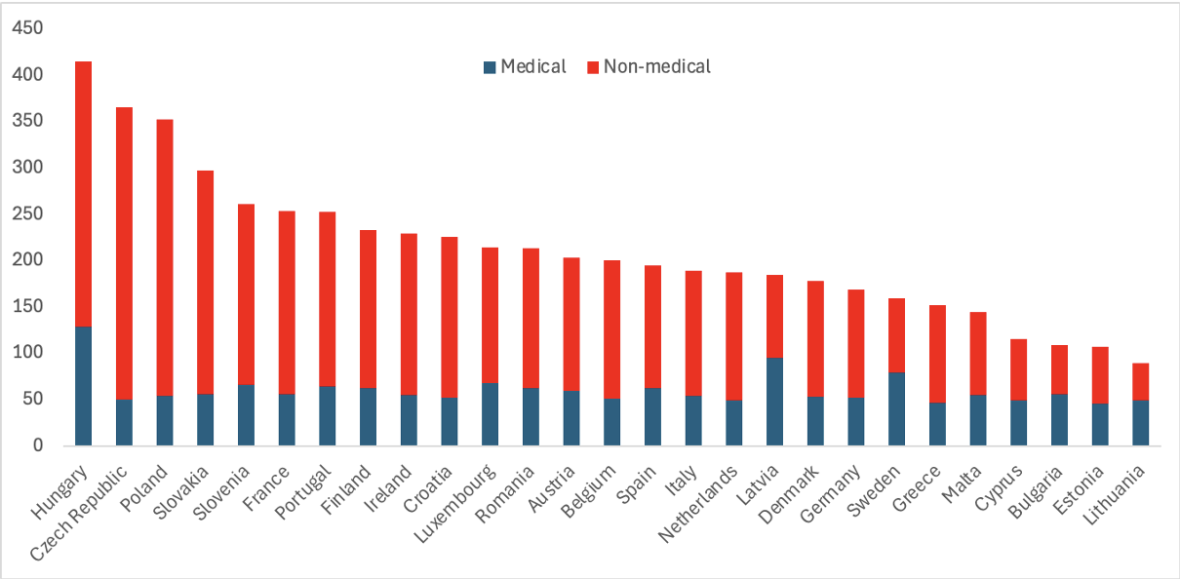
The total number of regulated professions in 2025 is 5,689.5 This figure provides a simple, if crude, measure of the aggregate obstacles to working in services outside the home EU country. More insight can be gained by drilling down into the data. As Figure 3 shows, variation across EU countries stems almost entirely from the number of non-medical professions included. Again, Hungary has the largest number, with 128 regulated medical professions. The median number of regulated medical professions is 55. Notably, Sweden has 79 regulated medical professions, considerably more than the EU average.
Figure 3. Medical and non-medical regulated professions, 2025.
Changes in EU regulated professions since 2023
Given that job creation is a key priority – not least as artificial intelligence (AI) is impacting the job market – how have MS dealt with the red tape surrounding regulated professions? The disconcerting answer is that regulation remains essentially unchanged. The total number of regulated professions in 2023 was 5,701, and in the latest vintage they totalled 5,689,6 a pro forma decrease of only 0.2 per cent.
Sweden is the country that has moved most in the wrong direction by having the largest percentage increase in regulated professions in 2023–25.
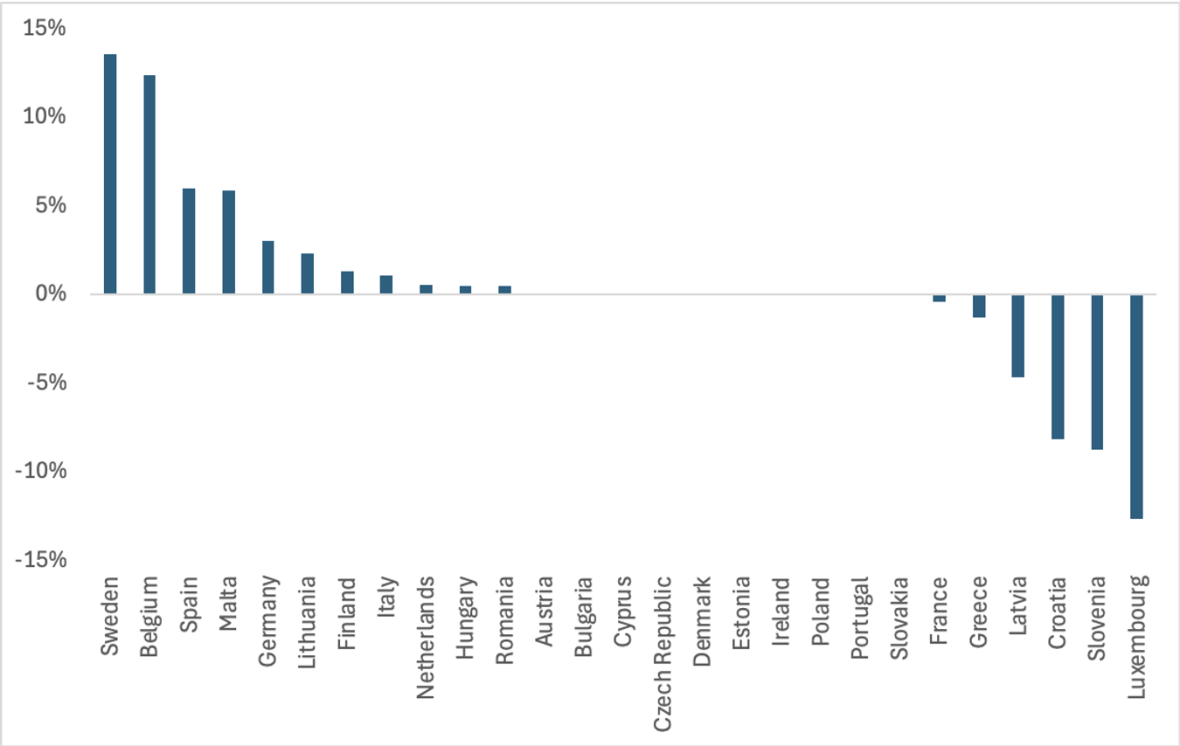
Although the total number of regulated professions is about the same between 2023 and 2025, some individual MS have improved, while others have moved in the opposite direction. Figure 4 shows that most countries (17 out of 27) remain at the same level, with a change of fewer than two restricted professions. The largest increase, with 14 per cent more regulated professions, is found in Sweden. The largest decrease is Luxembourg, with a 13 per cent reduction. While Sweden remains in the top quartile in terms of fewest regulated professions in the EU, the increase between 2023 and 2025 is a couple of steps in the wrong direction.7
Figure 4. Changes in regulated professions, 2023-25.
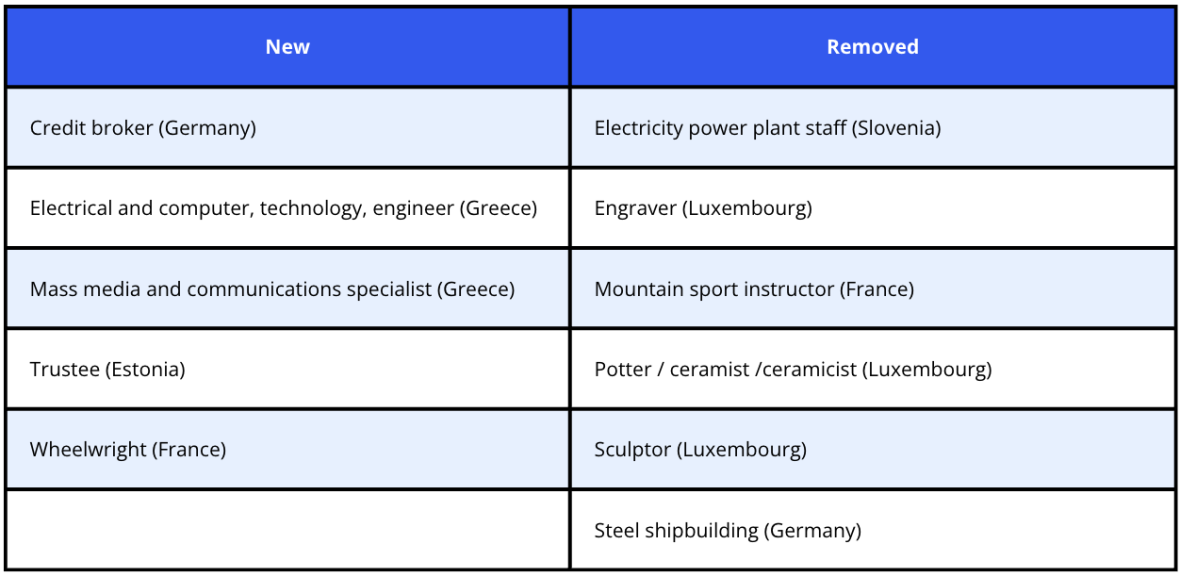
At an aggregate level, Table 1 lists the professions in 2025 that have been either added or removed. The fact that these changes are minor seem to indicate that EU countries, rather than the European Commission, remain in charge. There is no sign of a strategy towards less red tape or fewer regulated professions compared with 2023.
Table 1. New and removed regulated professions, 2025 compared with the 2023 vintage.
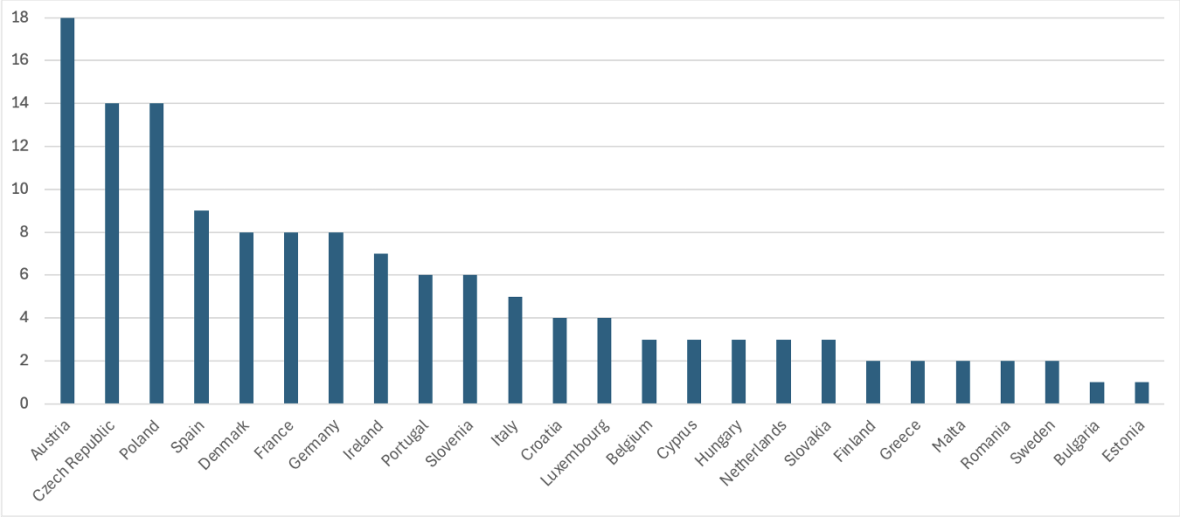
If the main argument for regulating a profession is that the consequences of not imposing restrictions would cause social harm, then it should appear on the lists of many, if not all, MS. Yet many professions are regulated in only one country. As can be seen in Figure 5, Austria is the sole regulator of 18 professions – a large number. Countries that have many such professions tend to be those where the professions have traditionally had a strong role and been able to protect the privileges of the group. Denmark, a country with relatively few restrictions and barriers to trade, nonetheless stands out as the sole regulator of 8 professions, a comparatively large number relative to its Nordic neighbours Sweden and Finland.
If professions with a sole regulator were removed from the database, the total would decrease by 138. This is not a major improvement, but it is at least a straightforward one.
Figure 5. Number of professions with a sole regulator, by country, 2025
While the public policy argument for deregulating the professions for which only one country is the regulator is simple, it can seem abstract. To make the oddities and flagrant protections behind the aggregates in Figure 5 clearer, let us be more specific. In Table 2, we show all professions regulated in one country only, in alphabetical order.
Table 2. Professions regulated in one country only, 2025.
| Austria | Arts therapist in the health service, assistant forester, bookbinder, communications electronics, debt-collector, draughtsman, forest ranger, forester, gardener, management consultant, manpower supply agent, manufacture of ladies’ and men’s clothing and linen, mechatronics, owner of a dance school, plastics processing, potholing guide, producer and wholesaler of pharmaceuticals and poisons, trade in medicinal products |
| Belgium | Assistant lecturer, civil protection officer / emergency services officer, corporate lawyer, railway station master |
| Bulgaria | Railway station master |
| Croatia | Lifeboat mechanic, photographer / photography, tailor (ladies/men’s)/dressmaker, wooden boatbuilding |
| Cyprus | Commercial agent, medical representative, recruitment agency manager (private) |
| Czech Republic | Alcohol and drug addiction counsellor, chartered technician, data processing/ cataloguing data, employment officer, gamekeeper, keeper of public records, lifeboat crew, manufacture / processing / import of dangerous chemicals, manufacture, handling and trade of security materials, plant expert, producer and distributor of animal foodstuffs, responsible of a laboratory animal centre, solariums/ beauty salon services, tour operator |
| Denmark | Building surveyor, domestic livestock trading professions, epoxide worker, farmer of genetically modified crops, fertiliser sample expert, maritime mediator, taxidermist, technician working with styrene |
| Estonia | Trustee |
| Finland | Ecclesiastical professions, seafaring professions |
| France | Airport fire officer / airport firefighter, boat-handling instructor (sea and inland), commodity broker, death care industry professions, director of artificial insemination centre, fishmonger, manager of boat-handling school (sea and inland), wheelwright |
| Germany | Barrelmaker /master cooper, credit broker, geriatric nurse/carer for the aged, manufacture of medico-surgical instruments and equipment and orthopaedic appliances (except orthopaedic footwear), medical secretary, rope/net maker/repairer, shipbuilding, wooden furniture maker |
| Greece | Electrical and computer (technology) engineer, mass media and communications specialist |
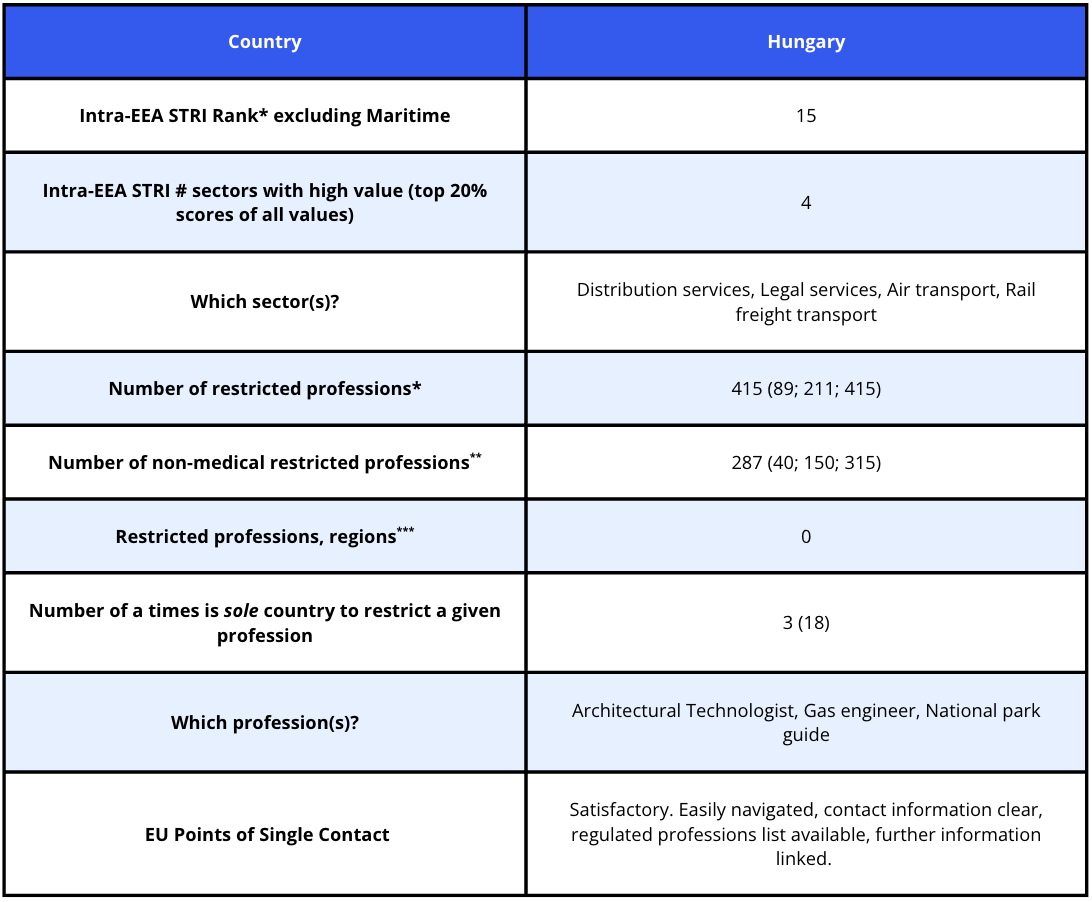
| Hungary | Architectural technologist, gas engineer, national park guide |
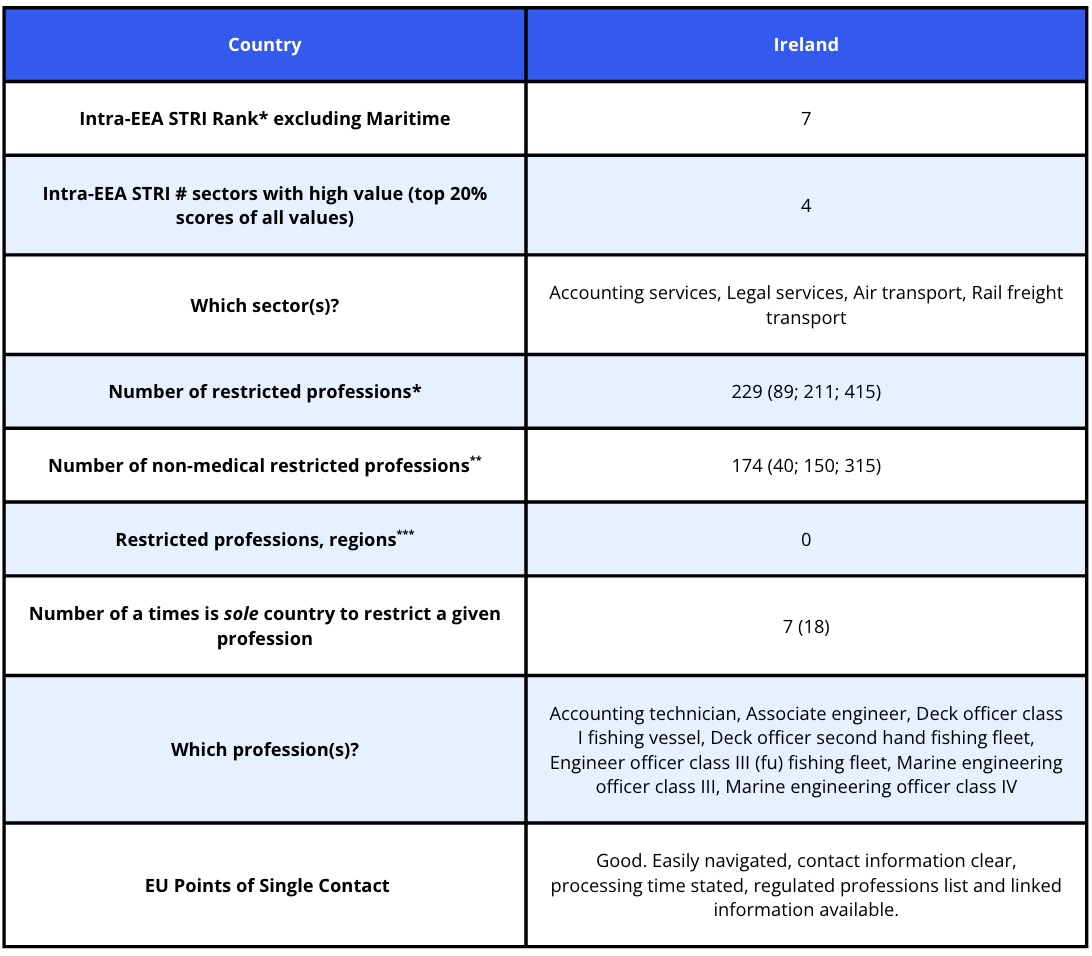
| Ireland | Accounting technician, associate engineer, deck officer class I fishing vessel, deck officer second hand fishing fleet, engineer officer class III (fu) fishing fleet, marine engineering officer class III, marine engineering officer class IV |
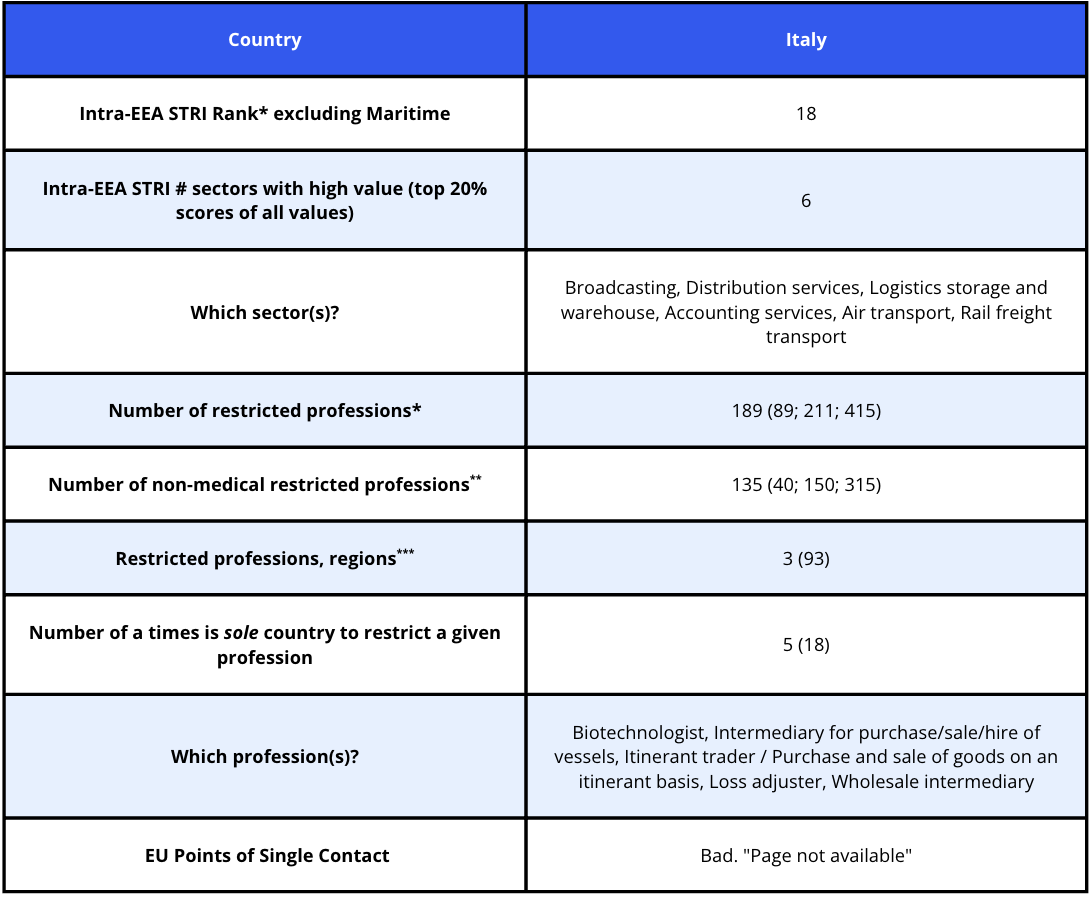
| Italy | Biotechnologist, intermediary for purchase/sale/hire of vessels, itinerant trader / purchase and sale of goods on an itinerant basis, loss adjuster, wholesale intermediary |
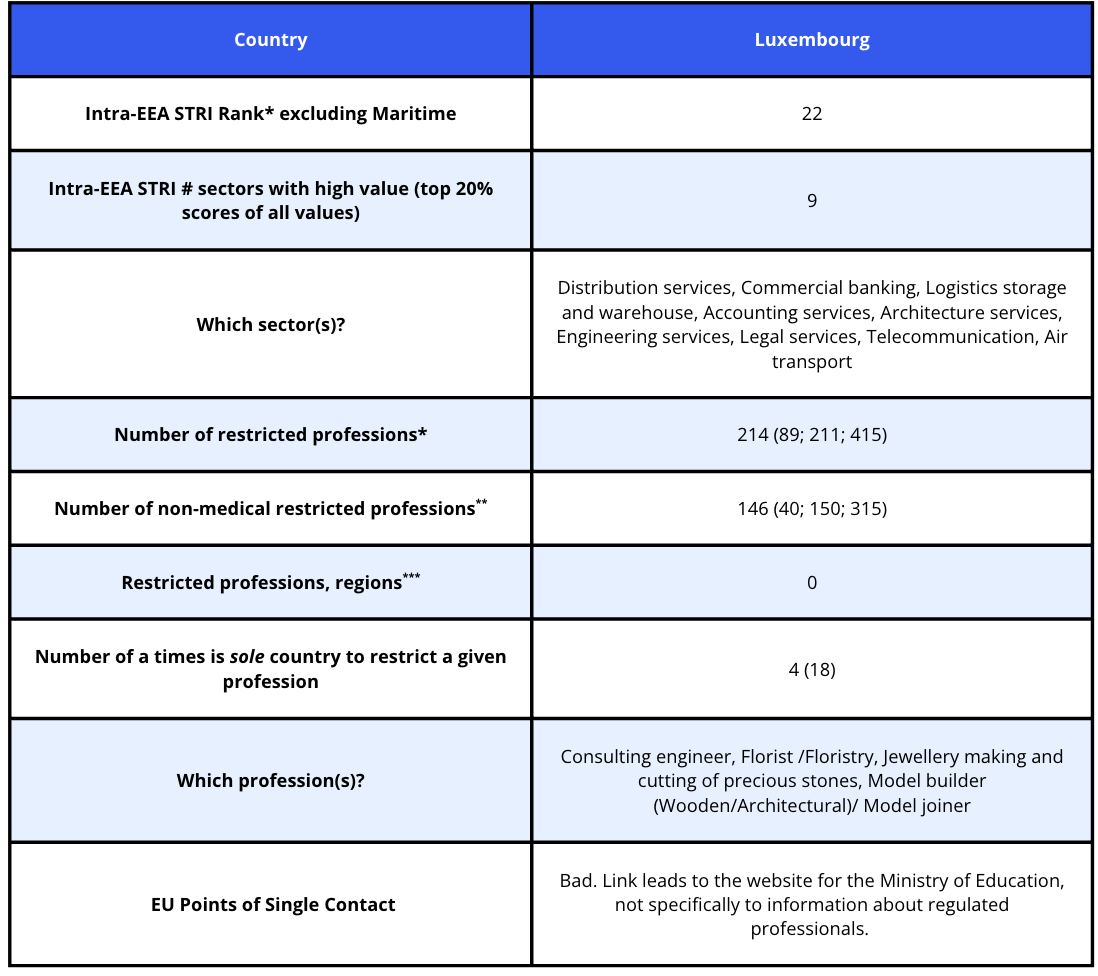
| Luxembourg | Consulting engineer, florist /floristry, jewellery making and cutting of precious stones, model builder (wooden/architectural)/ model joiner |
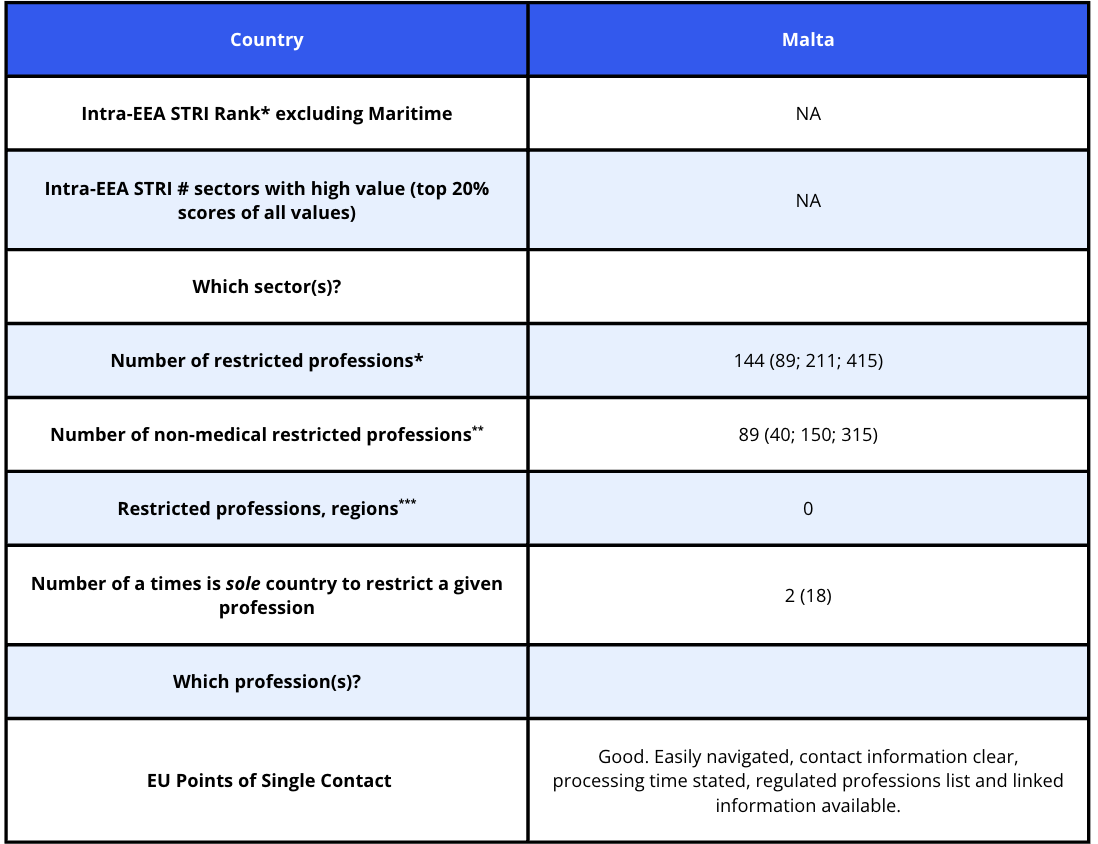
| Malta | Community worker, engineer (class II) merchant marine |
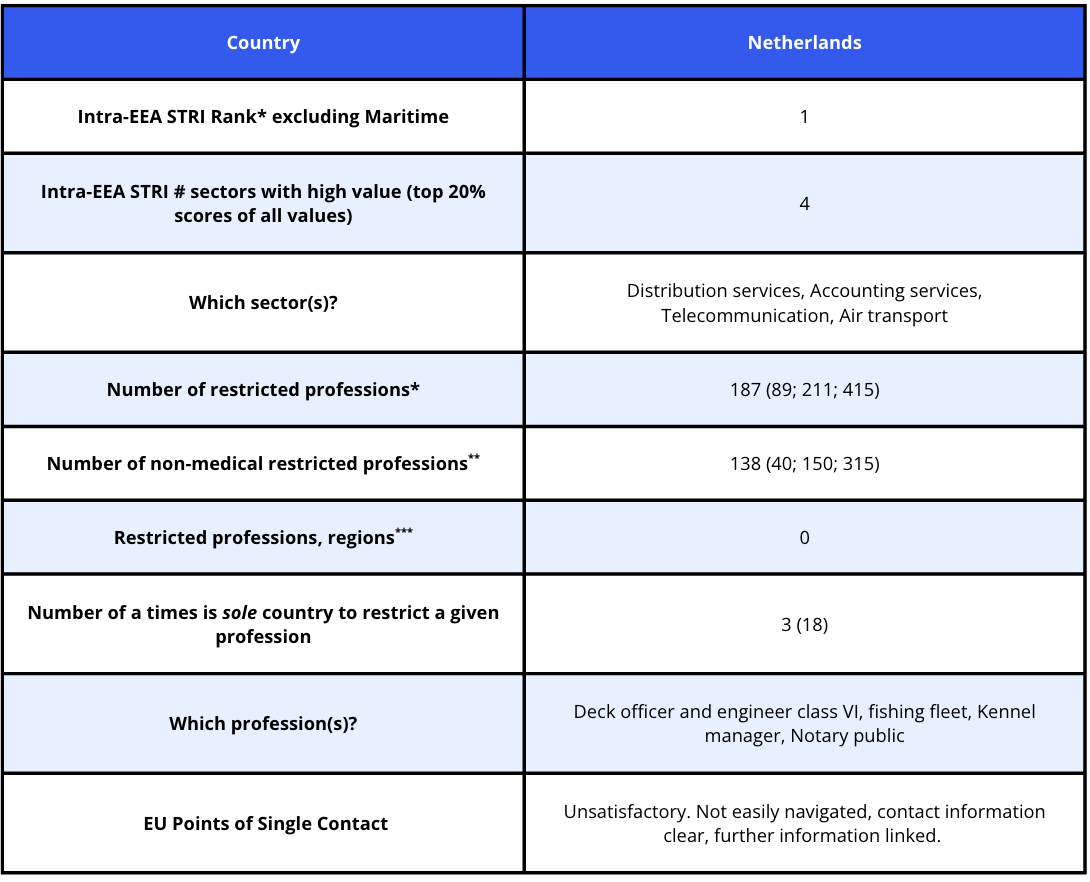
| Netherlands | Deck officer and engineer class VI, fishing fleet, kennel manager, notary public |
| Poland | Broker/stockbroker, civil and environmental engineer, coordinator of procurement and transplantation of cells, tissues and organs, crane technician, EU aviation security programme validator, feldsher, marine electro automation officer, national auditor in the field of aviation security, nuclear inspector, port worker, security screener (aviation security), skipper, home trade, tram driver, underground rail professions |
| Portugal | Agronomist-technician, cardiopneumographic technician, forest sapper, gambling and betting professions, precious metals tester, telecommunications infrastructure planner |
| Romania | Heavy goods vehicle standards officer, ship’s deck officer (inshore shipping) |
| Slovakia | Community health officer, engine maintenance/repair, inspector of weights and measures |
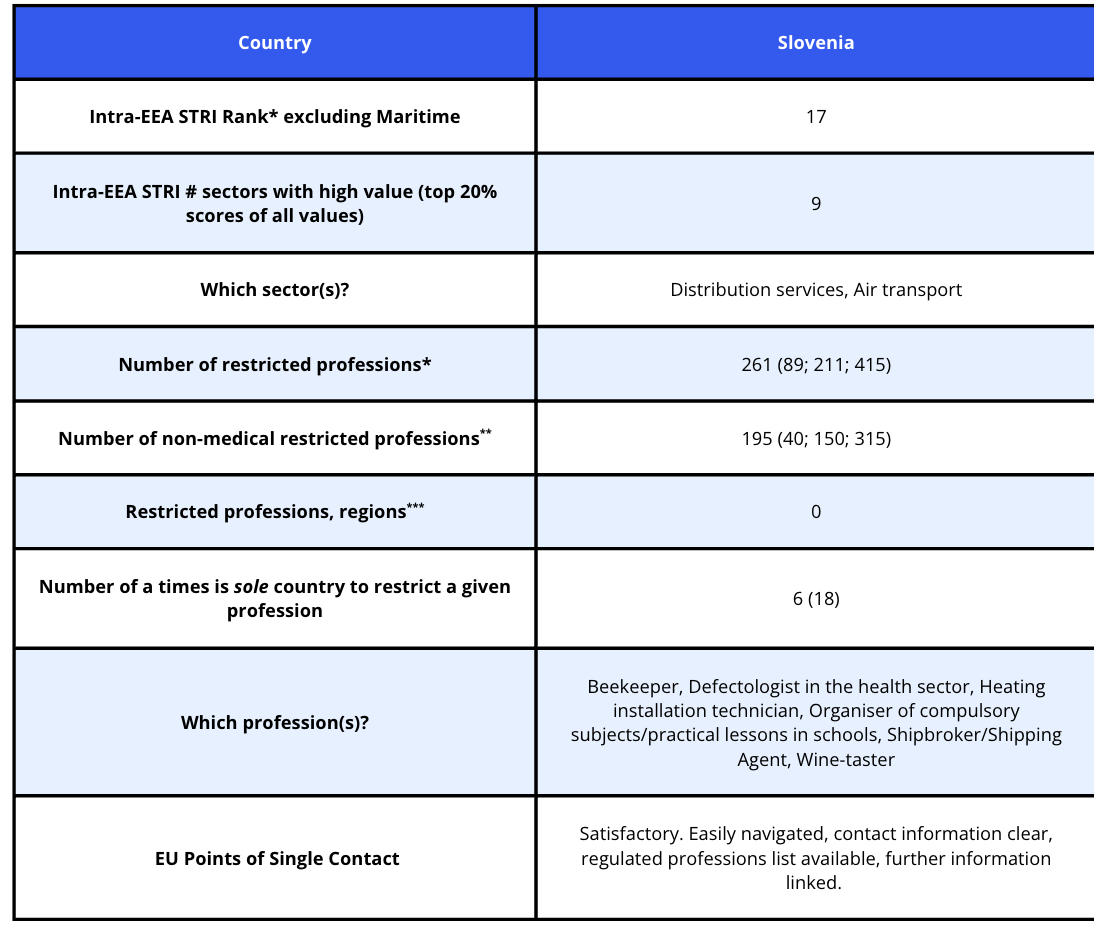
| Slovenia | Beekeeper, defectologist in the health sector, heating installation technician, organiser of compulsory subjects/practical lessons in schools, shipbroker/shipping agent, wine-taster |
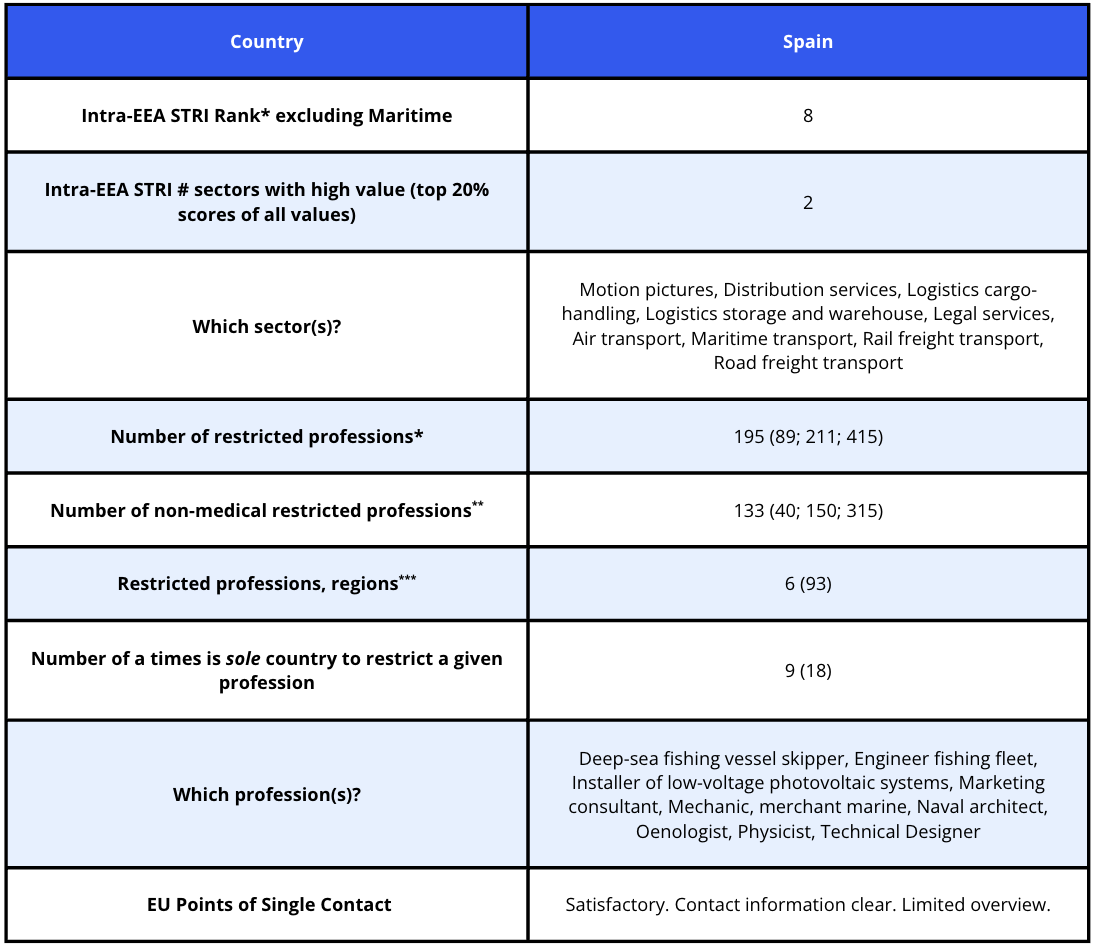
| Spain | Deep-sea fishing vessel skipper, engineer fishing fleet, installer of low-voltage photovoltaic systems, marketing consultant, mechanic, merchant marine, naval architect, oenologist, physicist, technical designer |
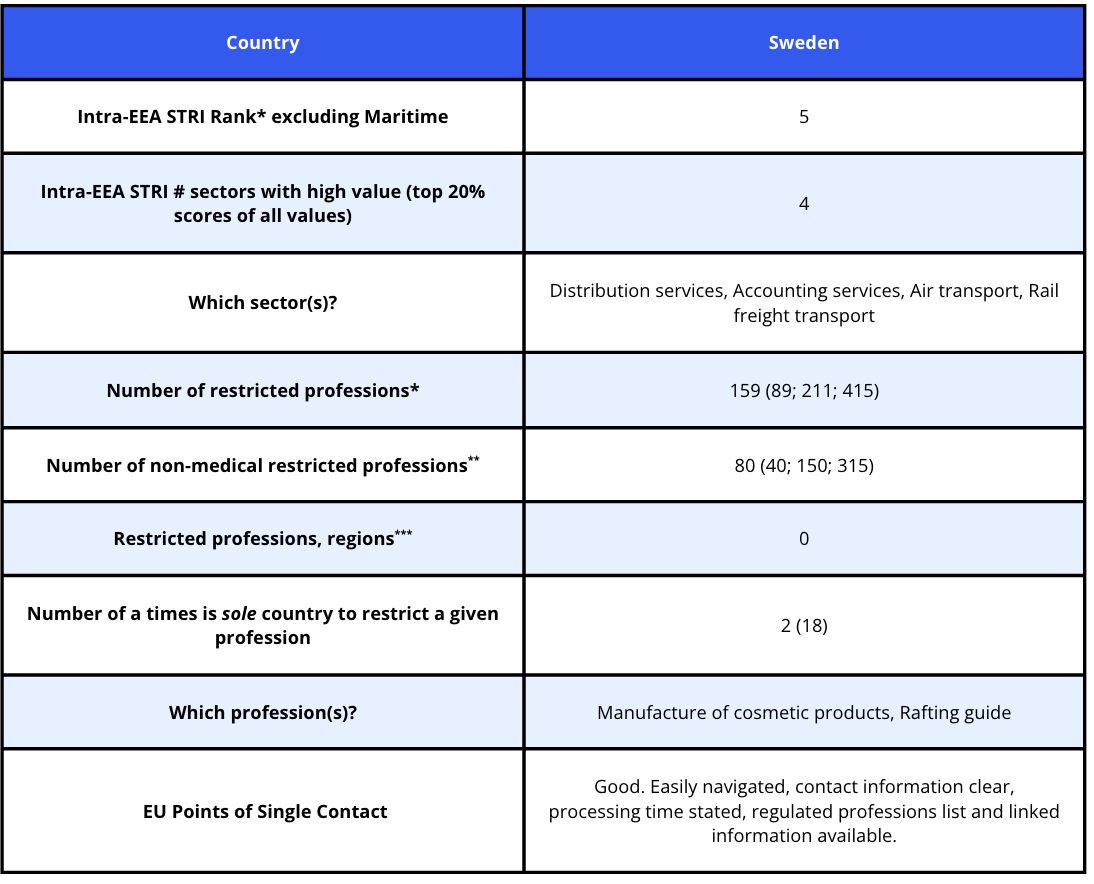
| Sweden | Manufacture of cosmetic products, rafting guide |
From this table, we have extracted some particularly egregious examples:
- Austria – Owner of a dance school, potholing guide.
- Cyprus – Plant expert.
- Italy – Loss adjuster.
- Slovenia – Beekeeper, Wine-taster
- Sweden – Rafting guide.
Regional red tape – regulation that differs within the same country
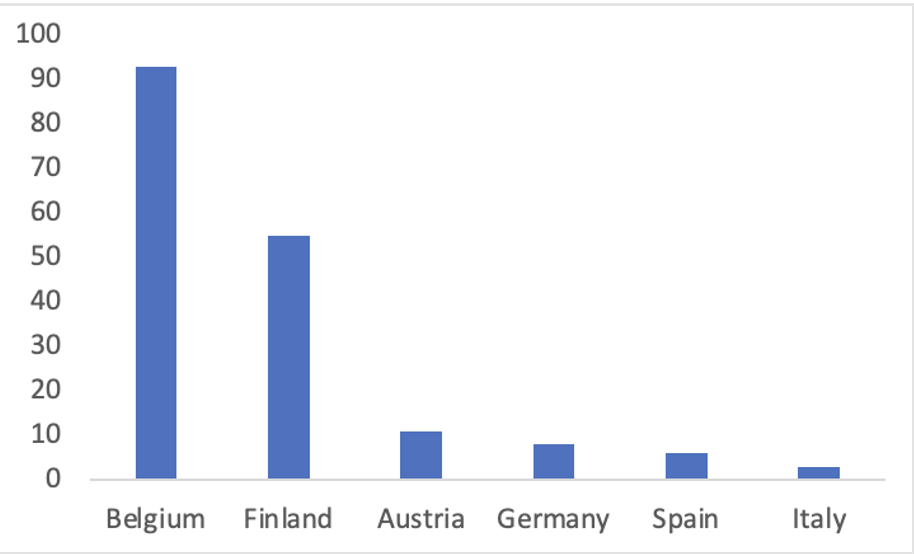
Not only do EU countries regulate professions in ways that hinder the free movement of labour in services across MS, some have different regulations within the same country, depending on the region. As Figure 6 shows, Belgium has the most regional restrictions, numbering 93. Finland also has a large number of such professions, which is more understandable as they stem from the semi-autonomous status of the Åland Islands. Other countries have only a few; most have none at all.
Figure 6. Number of region-specific regulations on professions, by country, 2025.
The OECD intra-European Economic Area Service Trade Restrictiveness Index (intra-EEA STRI) is a valuable tool for assessing obstacles to trade. It takes the value zero when there are no restrictions and one for a completely closed economy (i.e., the lower the number, the fewer the restrictions).
OECD intra-EEA STRI in 2024 compared with 2023
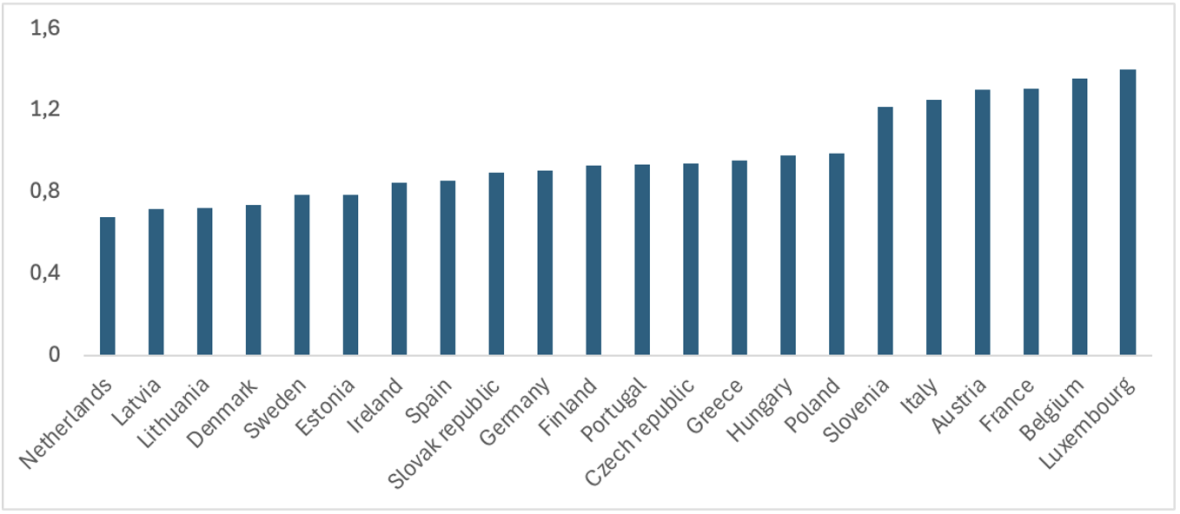
As can be seen in Figure 7, there are striking differences in intra-EEA STRI scores across EU countries – even though they are part of the EU Single Market.8 There have been only minor shifts in scores since 2023. The Netherlands remains at the top and Luxembourg at the bottom. Latvia is an exception: it has progressed from the lower third to second place between 2023 and 2024. Overall, however, over the last two years there has been considerable inertia in addressing the regulatory obstacles identified by the OECD.
Figure 7. OECD measure on trade restrictions in services for EU countries, 2024.
Changes over a longer period, 2014–2024
Over a longer time period, there are more changes in rank among EU countries. As Table 3 shows, the Netherlands remains the top performer, but some countries have moved up or down by a considerable amount. Notably, Latvia has made a big improvement, especially in the last two years. Both Sweden and Denmark have improved considerably over the time period 2014–2024.
Table 3. Comparison total rank from the OECD trade restrictiveness index for the European Economic Area, 2014 and 2024.
| Country | Rank 2025 (rank 2014) | Comment |
| Netherlands | 1 (1) | Still in first place |
| Latvia | 2 (11) | Large improvement |
| Lithuania | 3 (2) | |
| Denmark | 4 (14) | Large improvement |
| Sweden | 5 (15) | Large improvement |
| Estonia | 6 (3) | |
| Ireland | 7 (5) | |
| Spain | 8 (4) | |
| Slovak Rep. | 9 (6) | |
| Germany | 10 (16) | Improvment |
| Finland | 11 (8) | |
| Portugal | 12 (12) | |
| Czech Rep. | 13 (13) | |
| Greece | 14 (10) | |
| Hungary | 15 (9) | Deterioration |
| Poland | 16 (7) | Considerable deterioration |
| Slovenia | 17 (18) | |
| Italy | 18 (17) | |
| Austria | 19 (20) | |
| France | 20 (19) | |
| Belgium | 21 (22) | |
| Luxembourg | 22 (21) |
Countries and sectors with the most red tape
There are other ways to extract information from the STRI database that showcase the relative performance of each country and highlight those that frequently exhibit high levels of regulation. Let us consider the number of times a country appears in the top 20 per cent in the OECD index, i.e. has high levels of red tape and obstacles for trade in services. As Figure 8 shows, using this definition, Denmark has high red tape in only one instance (air transport), while Luxembourg does in 9 areas. The Netherlands is the best performer overall (Figure 7), but Figure 8 illustrates that it, too, can improve in some areas. About 40 per cent of the countries have high red tape in three or four categories, which can pinpoint areas where structural reforms should be prioritized for specific countries (see also Appendix B for a country-based summary).
The Netherlands is the top performing country in having the least regulation, but it too could improve significantly in at least two sectors.
Figure 8. Number of times a country falls in the top 20 per cent in the OECD trade restrictiveness index for the European Economic Area, 2024
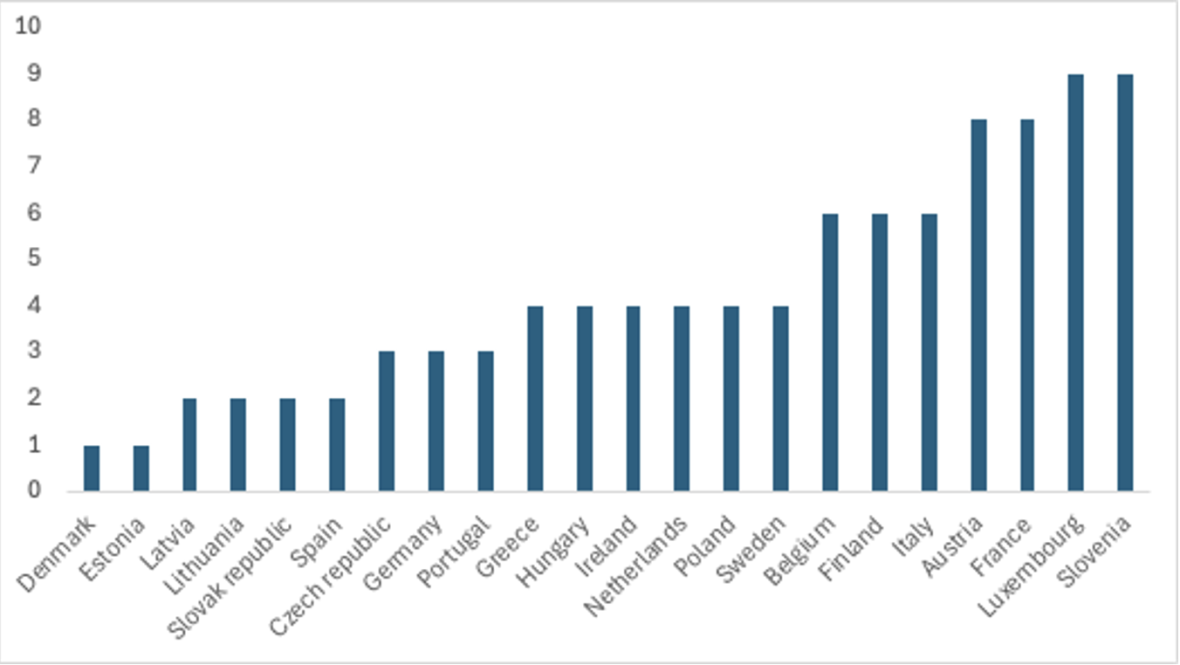
It is also useful to look at the countries with the highest restrictions in each category (see Table 4). These countries should consider their rationale for having the most regulation in these areas and whether to prioritise them for reform. By contrast, the remaining EU countries that are also in the OECD are never the highest regulator in any category.
Table 4. Number of times with highest restrictions for a specific sector, 2025.
| Country | Nr | Sectors |
| Slovenia | 5 | Motion pictures, insurance, logistics cargo-handling, logistics storage and warehouse, maritime transport |
| Luxembourg | 4 | Construction, commercial banking, accounting services, engineering services |
| Belgium | 3 | Courier services, logistics customs brokerage, architecture services |
| Italy | 3 | Computer services (shared 1st place with Austria), broadcasting, sound recording |
| Austria | 2 | Computer services (shared 1st place with Italy), logistics freight forwarding |
| France | 2 | Distribution services, rail freight transport (shared 1st place with Latvia) |
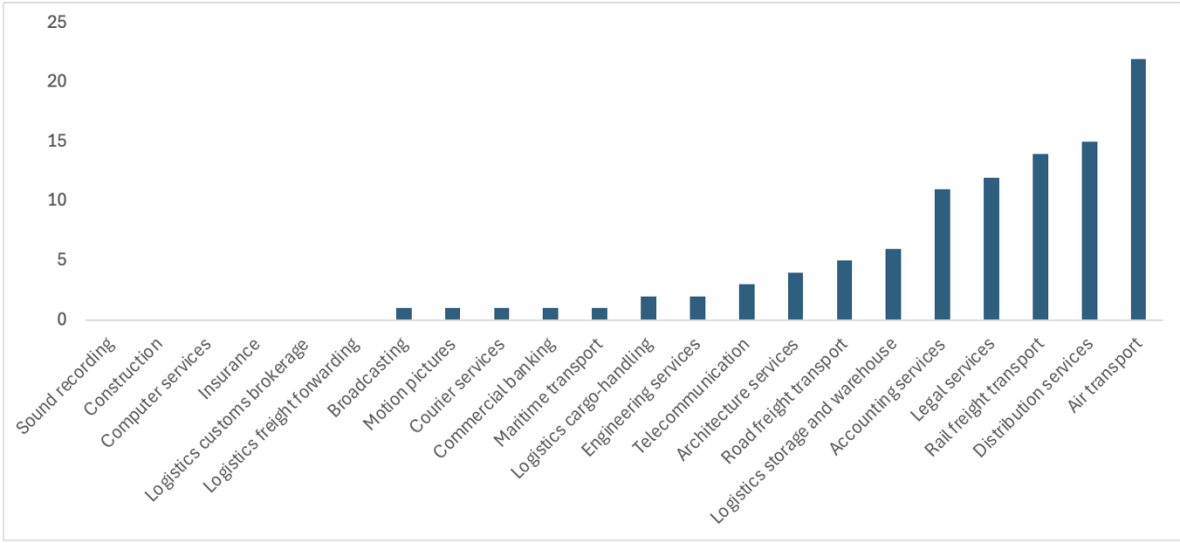
In Figure 9, we invert the lens and show the number of times a sector appears among those regulated by countries in the top 20 per cent of OECD trade restrictiveness index. Sound recording and construction have few restrictions across MS, while air transport has the most. All EU countries have major regulation for air transport, followed closely by distribution services and rail freight transport.
Figure 9. Number of times a sector appears among those countries with high trade obstacles, 2024
Identifying priorities for regulatory reform
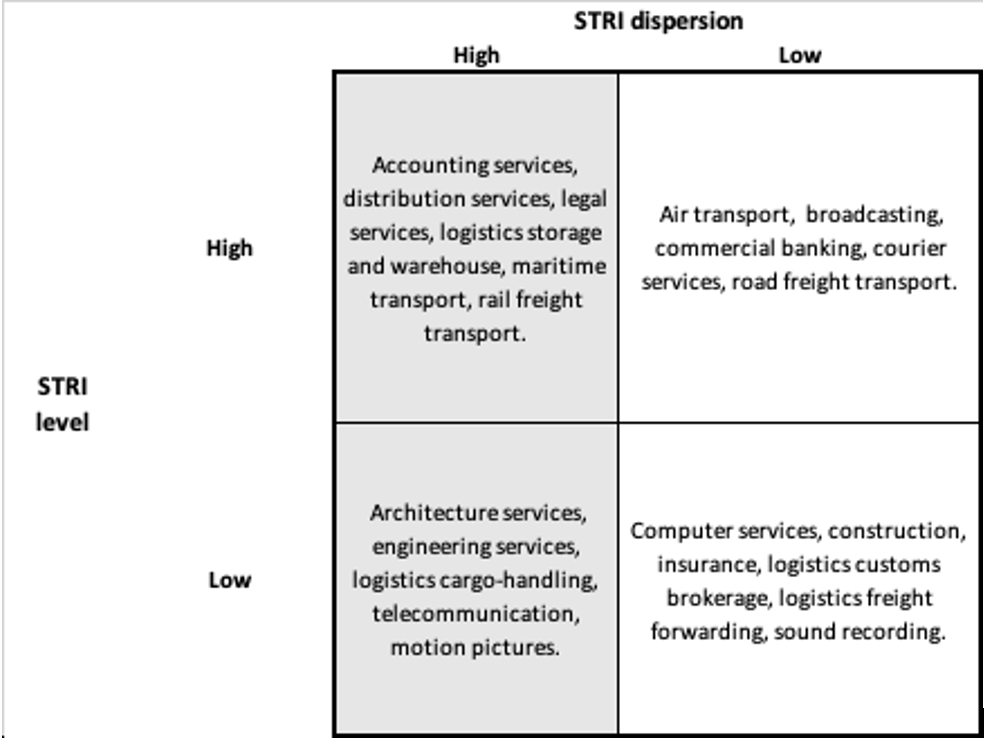
We now combine the information above data to indicate areas to prioritize for reform. The key question is: given these regulatory barriers, which areas should be the main focus? One approach is to consider both the level of trade obstacles in a sector, and how unevenly they are applied across EU/EEA countries (the variance).
To do this, we rank countries by the size of their OECD intra-EEA STRI score and split them into two groups: those above and below the median. The same is done for the variance, creating four categories:
- High trade obstacles and high variance
- High trade obstacles but low variance
- Low trade obstacles but high variance
- Low trade obstacles and low variance
Sectors in the lower right quadrant (low obstacles and low variance) are not priority areas for reform, since competition conditions are already comparatively good. Similarly, the upper right quadrant (high obstacles, low variance) may reflect legitimate public-interest concerns rather than competition issues, making reforms less pressing.
By contrast, reforms should be considered for sectors on the left-hand side of the figure:
- High obstacles and high variance: Countries appear to adopt very different approaches. Where obstacles are high (for example, in legal or distribution services), countries should reassess whether the restrictions are truly in the public interest or primarily the result of lobbying by special interests.
- Low obstacles but high variance: A few countries impose unusually high restrictions compared with their peers.
Figure 10. Sectors for regulatory reform
The European Commission provides Points of Single Contact (PSCs), a service intended to make it easier for companies or individuals to work or sell services in other EU countries. By collecting the relevant links one place at the EU level, in theory it should no longer be necessary to find and navigate idiosyncratic web structures in different countries.
In practice, the PSCs fall short of this ambition. Table 5 summarizes the current state across EU countries. Whether or not a web site is good contains an inevitable element of subjectivity, so to make the assessment structured and transparent, each country’s website is scored according to a clear metric, with points summed to yield a total quality score (see Appendix A).8 This quality assessment reveals that roughly half of country sites are bad or unsatisfactory, and the remaining half are satisfactory or good (10, bad; 3, unsatisfactory;7, satisfactory; 7, good).
It is noteworthy that there is no clear connection between the quality of the websites and the extent of red tape. For example, Hungary and the Czech Republic are among the countries with the most regulated professions but receive satisfactory quality scores on their web sites. The Netherlands has the best score in the index but a bad website; Austria has one of the worst scores and the most idiosyncratically regulated professions, yet it has a good website. Countries receiving top marks on their web sites are Denmark, Finland, Ireland, Lithuania, Malta, and Sweden. Low performers include France and Germany – countries that should set a good example for smaller EU countries. Overall, the PSCs are useful, but many EU countries need to address simple and flagrant design issues.
Table 5. Assessment of Points of Single Contact on restricted professions, 2025.
| Country | Language | Description of website content | Quality of content |
| Austria | English | Easily navigated, contact information clear, processing time stated, regulated professions list and linked information available. | Good |
| Belgium | English | Fairly easily navigated, all relevant information is available | Satisfactory |
| Bulgaria | Bulgarian; English | Not easily navigated, a lot of non-relevant information | Bad |
| Croatia | No website linked | Bad | |
| Cyprus | English | Fairly easily navigated, relevant information linked. | Satisfactory |
| Czech Rep. | English | Easily navigated, contact information and process time available, limited other information. | Satisfactory |
| Denmark | English | Easily navigated, contact information clear, regulated professions list available, further information linked. | Good |
| Estonia | No website linked | Bad | |
| Finland | English | Easily navigated, contact information clear, processing time stated, regulated professions list and linked information available. | Unsatisfactory |
| France | Link does not work | “Page not available” | Bad |
| Germany | English; German | Not easily navigated. Linked information. | Satisfactory |
| Greece | Greek | No translation easily available on the website. Information not relevant at all, general ministry website only. | Bad |
| Hungary | English | Easily navigated, contact information clear, regulated professions list available, further information linked. | Satisfactory |
| Ireland | English | Easily navigated, contact information clear, processing time stated, regulated professions list and linked information available. | Good |
| Italy | Link does not work | “Page not available” | Bad |
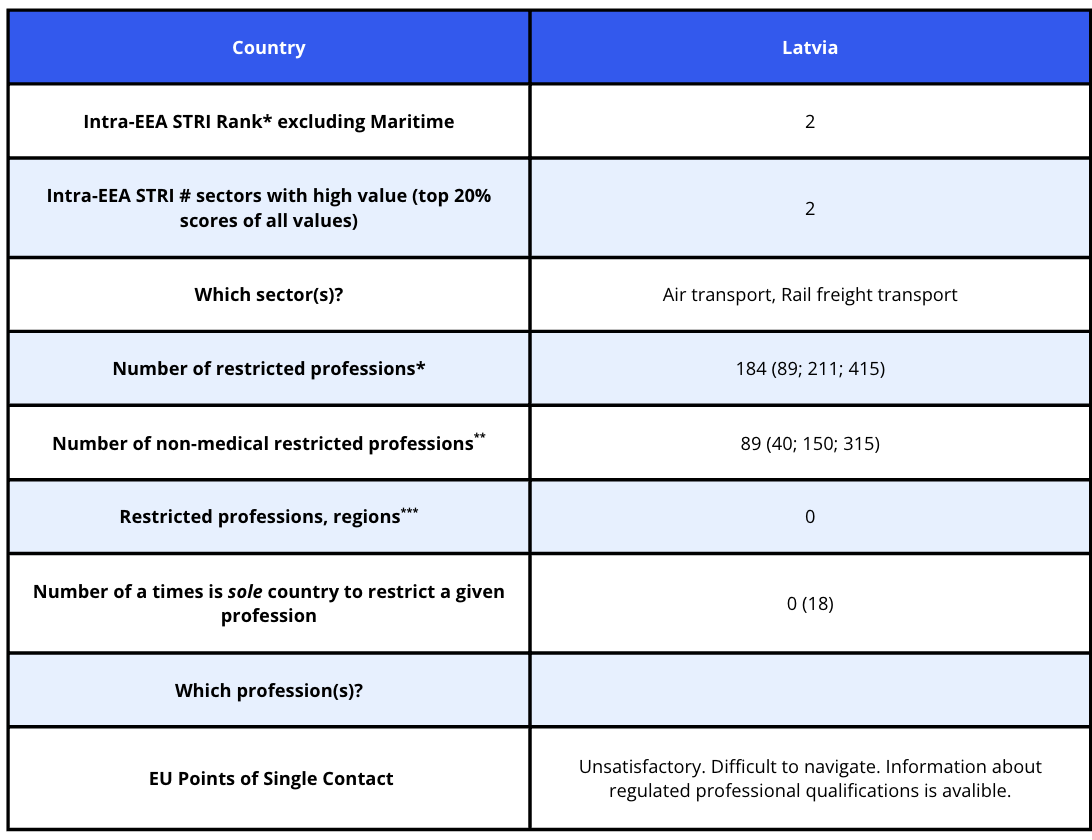
| Latvia | Latvian; English | Difficult to navigate. Information about regulated professional qualifications is available. | Unsatisfactory |
| Lithuania | English | Easily navigated, contact information clear, processing time stated, regulated professions list and linked information available. | Good |
| Luxembourg | English | Link leads to the website for the Ministry of Education, not specifically to information about regulated professionals. | Bad |
| Malta | English | Easily navigated, contact information clear, processing time stated, regulated professions list and linked information available. | Good |
| Netherlands | Dutch; English | Not easily navigated, contact information clear, further information linked. | Unsatisfactory |
| Poland | Polish | No translation easily available, general government website only. | Bad |
| Portugal | Portugese | Translation easily available, easily navigated, contact information clear, regulated professions list and information available. | Satisfactory |
| Romania | Romanian; English; French | Not easily navigated, overview of information for recognition of studies. | Bad |
| Slovak Rep. | Slovak; English | Link leads to the website for the Ministry of education. not to information about regulated professionals. | Bad |
| Slovenia | English | Easily navigated, contact information clear, regulated professions list available, further information linked. | Satisfactory |
| Spain | Spanish; English | Contact information clear. Limited overview. | Satisfactory |
| Sweden | English | Easily navigated, contact information clear, processing time stated, regulated professions list and linked information available. | Good |
Reducing the number of regulated professions is on the surface a straightforward exercise. In practice, it has proven difficult—whether due to lack of political will or complications that take time to address. It is easy to be overwhelmed by the sheer detail of red tape and regulated professions. The complexity itself is an obstacle, and it does not help that the groups wishing to deregulate is less cohesive than those protecting the status quo. Whatever the reason, the number of regulated professions is essentially unchanged between 2023 and 2025, a clear sign that progress is hard. Indeed, the slow and dismal progress on deregulation is an indication – if one were needed – that Europe’s deregulation agenda needs to kick into a different gear.
The lack of progress on reducing the EU regulated professions is a clear sign that the current piecemeal approach does not work.
Before outlining a possible agenda, it should be noted that air transport has the most red tape of all sectors by a wide margin. In Figure 10, this would put it a category with lower priority for reform. Nonetheless, EU countries should collectively ask whether some deregulation of air transport is possible, or at least set a path towards less regulation.
Another area for improvement for about half the EU countries is their web sites within the PSC system. There is no excuse for poor websites, given the digital tools available and the broader digital transformation across sectors.
The reform agenda suggested by the analysis in this paper has two concurrent parts:
- Sector-specific deregulation in the Single Market;
- Reducing the regulated professions to an absolute minimum.
For sector specific deregulation, reforms should target areas with high dispersion (large variance) in OECD intra-EEA STRI index combined with sectors that have either low or high levels of the index, including accounting services, legal services, and rail freight services (the top-left quadrants of Figure 10). Why? High dispersion implies that some countries manage with less regulation; the onus should be on countries with substantial red tape to reduce their bureaucratic burden. The same argument applies more strongly for sectors with low levels of the index but high variance: clearly, a few outlier countries need to move closer to their peers with less regulation.
A simple step would be to remove all professions that are regulated in one country only.
Blix (2023) suggested prioritizing removal of non-medical regulated professions that are regulated in only a few countries. In the most extreme case, there are 138 non-medical professions that are regulated in one country only (see Figure 5 above). A simple step would be to remove all those at once. But why stop there? In Figure 11, we conduct a thought experiment. First, assume that all professions with the same generic translation in English are treated as the same occupation (i.e. if the generic translation is for example driving instructor, then it is the same kind of job regardless of country). Next, what happens to the number of regulated professions if we remove those that are only regulated in 1, 2, 3… etc. countries? This results in Figure 11. Imposing a modest requirement – that many EU countries must regulate a profession for it to be warranted – drastically reduces the total number. For example, if we only accept those non-medical regulated professions that are common in 7 EU countries, there would only be about 96 regulated professions in the EU. The result is almost identical to Blix (2023).
Figure 11. Reducing the number of regulated professions according to a simple rule, 2025.
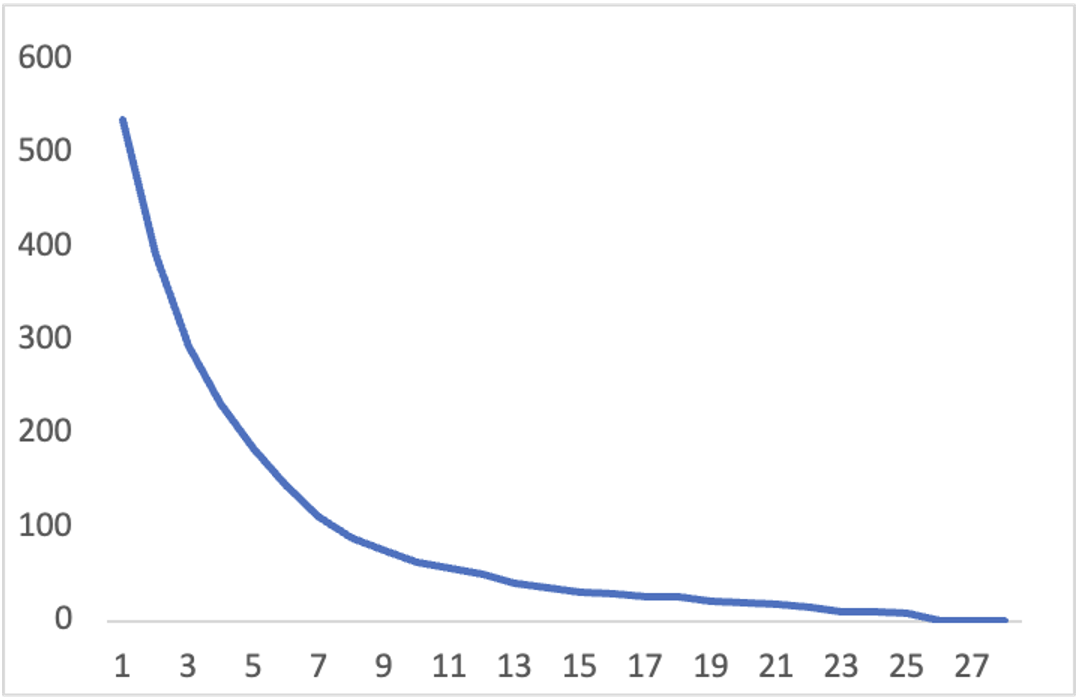
Why exclude medical professions from this deregulation thought experiment? There are two reasons. First, medicine is governed by specific regulation and is a sensitive area. Second, why begin with probably the most difficult sector, when Figure 10 presents a simpler strategy for deregulation?
The advantage of this approach to reducing the number of regulated professions is that it is straightforward and simple. If only a few countries deem a profession to need regulation, while others do not, the societal argument for state interference is likely weak. The arguments are unlikely to withstand scrutiny in a structured process of reducing red tape. In Table 6, we list the concrete professions that would be deregulated if the rule were applied.
| Profession | 15 | 16 | 17 | 18 | 19 | 20 | 21 | 22 | 23 |
| Accountant/ Tax advisor | X | X | X | X | X | ||||
| Air conditioning technician/Heating/Central heating technician/installer/repairer/ Maintenance-Installation of ventilation equipment | X | X | |||||||
| Architect | X | X | X | X | X | X | X | X | X |
| Chiropodist (podiatrist) | X | X | X | ||||||
| Civil engineer | X | ||||||||
| Dental hygienist | X | X | X | ||||||
| Dental Practitioner | X | X | X | X | X | X | X | X | X |
| Dental technician | X | X | X | X | X | X | X | X | X |
| Dietician | X | X | X | X | X | X | X | X | |
| Doctor of Medicine | X | X | X | X | X | X | X | X | X |
| Driving instructor | X | X | X | X | X | X | X | X | X |
| Kindergarten teacher/ Nursery school teacher/Preparatory school teacher | X | X | X | X | X | ||||
| Lawyer/Barrister/Solicitor | X | X | X | X | X | X | X | X | X |
| Medical/Biomedical laboratory technician | X | X | X | X | X | X | |||
| Midwife | X | X | X | X | X | X | X | X | X |
| Nurse | X | X | X | X | X | X | X | X | X |
| Nursing Assistants and Health Care Assistants | X | X | |||||||
| Occupational therapist | X | X | X | X | X | X | X | X | X |
| Patent Agent / Trademark agent | X | X | X | X | X | ||||
| Pharmaceutical technician/Pharmaceutical assistant | X | X | X | X | X | X | |||
| Pharmacist | X | X | X | X | X | X | X | X | X |
| Physiotherapist | X | X | X | X | X | X | X | X | |
| Primary school teacher | X | X | X | X | X | X | X | X | |
| Private detective | X | ||||||||
| Prosthetist and orthotist / Orthopaedic technician /Surgical truss-maker | X | X | |||||||
| Psychologist | X | X | X | X | X | X | X | X | X |
| Radiographer / Radiotherapist | X | X | X | X | X | X | X | X | X |
| Real Estate agent /Real estate agency manager/administrator/director | X | X | |||||||
| Secondary school teacher | X | X | X | X | X | X | X | X | X |
| Security guard / Warden | X | X | X | X | X | X | X | ||
| Social worker | X | X | X | X | X | X | X | ||
| Speech and language therapist | X | X | X | X | X | X | X | X | |
| Statutory auditor | X | X | X | X | |||||
| Veterinary Surgeon | X | X | X | X | X | X | X | X | X |
| Sum of regulated professions | 35 | 33 | 30 | 27 | 26 | 23 | 21 | 19 | 16 |
Table 6. A ‘minimalist’ list of regulated professions in the EU
The burden should be on countries to justify why a profession should be on the list in the first place.
The problem with this strategy is that it still represents the piecemeal approach that has not worked in the past. An alternative strategy is instead a ‘big bang’ approach. Let us start with the assumption that only medical professions should be regulated. All others should be deregulated unless a majority of EU countries agree. Instead of putting the onus on removing professions from the list, the burden should be on countries to justify why a profession should be on the list in the first place. Going further, it is time to consider a major reform for trade in services: The principle of mutual recognition in place for trade in goods should also as a general rule apply for services: if a service is approved in one EU country, it should also be approved in all other countries.
It is high time to consider a “big bang” reform for trade in services: The principle of mutual recognition in place for trade in goods should also as a general rule apply for services.
The EU has an aging populating with mounting pressures on public finances on top of already high levels of debt in many countries – often well in excess of the Maastricht maximum of 60 per cent as share of GDP. Some major EU countries have been unable to balance their budgets for a long time.
Outside the EU, China and other Asian countries are ferociously competing in services and goods production, not least in digital technologies. Most of the highly capitalized companies in the world are either Asian or American, especially if the list is restricted to tech firms.
Europe needs to boost its productivity growth to retain its competitiveness. The main – and only – way to lay the groundwork for future growth is through an agenda of deregulation, especially for services in the EU. Compared to goods, services remain burdened by excessive red tape and bureaucracy.
So far there is more talk about growth than actual policy reform. A pragmatic agenda for deregulation would target the low-hanging fruit in services, especially those with high levels of restrictions and dispersion across EU countries. Moreover, instead of a piecemeal reduction in regulated professions, it would be simpler to just require EU countries to justify why a specific non-medical profession should remain on the list, rather than engage in in a lengthy procedure to decide which may be removed.
The snail pace of reform in the EU together with the lack of productivity growth show that something else is urgently needed. The EU should consider a “big bang” reform for trade in services: The principle of mutual recognition in place for trade in goods should also as a general rule apply for services. The time is now to pick up the pace of deregulation; otherwise, Europe’s growth problem will become Europe’s welfare problem, as captured succinctly in the Draghi report.
| Country | English | Navigation | Relevance | Clarity | Processing time | Sum | Quality assessment |
| Austria | 3 | 3 | 3 | 2 | 1 | 12 | Good |
| Belgium | 3 | 1 | 3 | 1 | 0 | 8 | Satisfactory |
| Bulgaria | 1 | 1 | 1 | 1 | 0 | 4 | Bad |
| Croatia | 0 | 0 | 0 | 0 | 0 | 0 | Bad |
| Cyprus | 3 | 3 | 1 | 1 | 0 | 8 | Satisfactory |
| Czech Rep. | 3 | 3 | 1 | 2 | 1 | 10 | Satisfactory |
| Denmark | 3 | 3 | 3 | 2 | 0 | 11 | Good |
| Estonia | 0 | 0 | 0 | 0 | 0 | 0 | Bad |
| Finland | 3 | 3 | 3 | 2 | 1 | 12 | Good |
| France | 0 | 0 | 0 | 0 | 0 | 0 | Bad |
| Germany | 3 | 1 | 1 | 2 | 0 | 7 | Unsatisfactory |
| Greece | 0 | 0 | 0 | 0 | 0 | 0 | Bad |
| Hungary | 3 | 1 | 3 | 2 | 0 | 9 | Satisfactory |
| Ireland | 3 | 3 | 3 | 2 | 0 | 11 | Good |
| Italy | 0 | 0 | 0 | 0 | 0 | 0 | Bad |
| Latvia | 1 | 1 | 3 | 1 | 0 | 6 | Unsatisfactory |
| Lithuania | 3 | 3 | 3 | 2 | 1 | 12 | Good |
| Luxembourg | 3 | 0 | 0 | 0 | 0 | 3 | Bad |
| Malta | 3 | 3 | 3 | 2 | 1 | 12 | Good |
| Netherlands | 1 | 1 | 3 | 2 | 0 | 7 | Unsatisfactory |
| Poland | 0 | 0 | 0 | 0 | 0 | 0 | Bad |
| Portugal | 1 | 3 | 3 | 2 | 0 | 9 | Satisfactory |
| Romania | 1 | 1 | 1 | 1 | 0 | 4 | Bad |
| Slovak Rep. | 1 | 0 | 0 | 0 | 0 | 1 | Bad |
| Slovenia | 3 | 3 | 3 | 1 | 0 | 10 | Satisfactory |
| Spain | 3 | 3 | 1 | 2 | 1 | 10 | Satisfactory |
| Sweden | 3 | 3 | 3 | 2 | 1 | 12 | Good |
Location of identified websites (clickable links, where available)
| Austria | Estonia | Italy | Portugal |
| Belgium | Finland | Latvia | Romania |
| Bulgaria | France | Lithuania | Slovak Rep. |
| Croatia | Germany | Luxembourg | Slovenia |
| Cyprus | Greece | Malta | Spain |
| Czech Rep. | Hungary | Netherlands | Sweden |
| Denmark | Ireland | Poland |
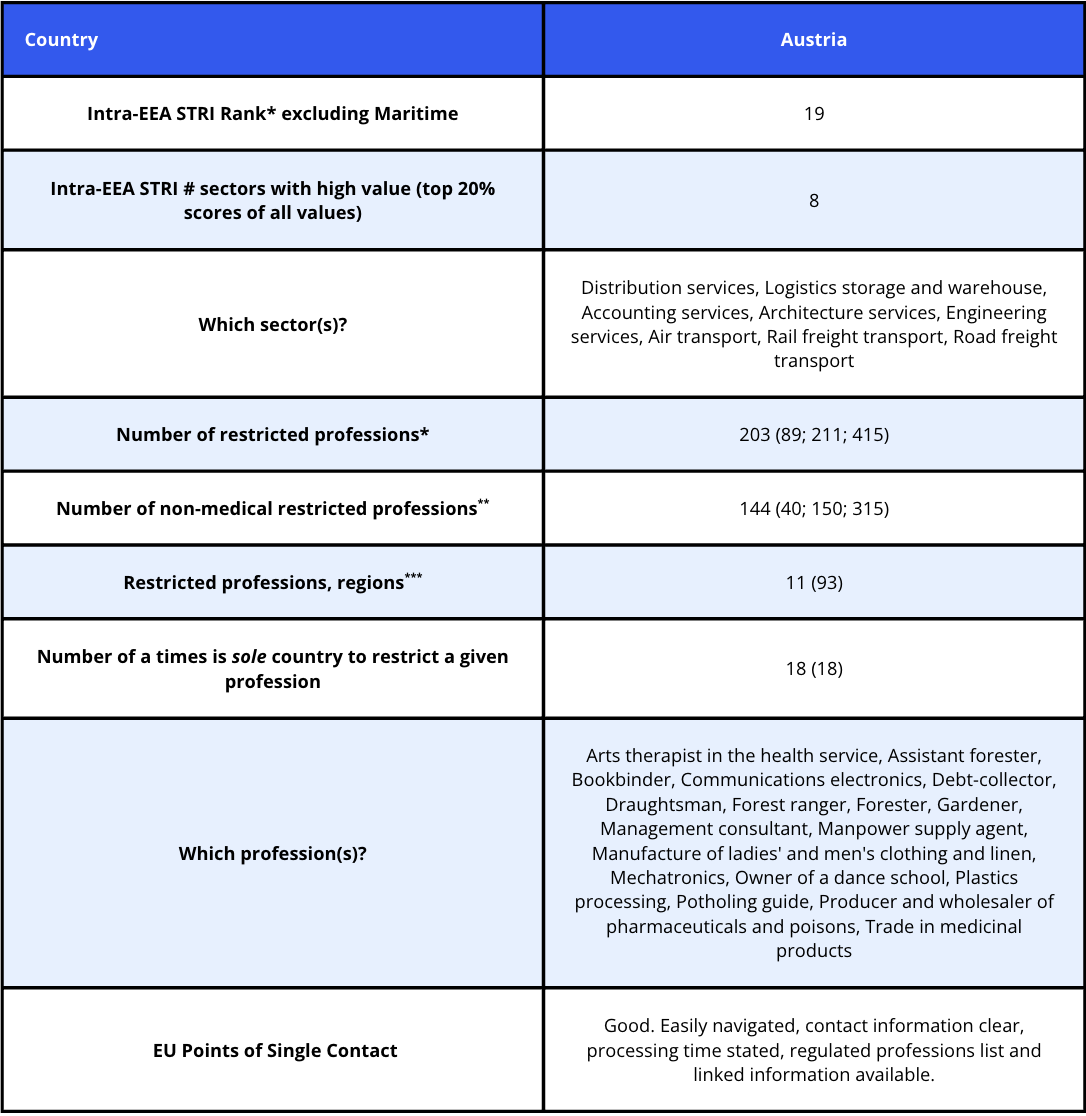
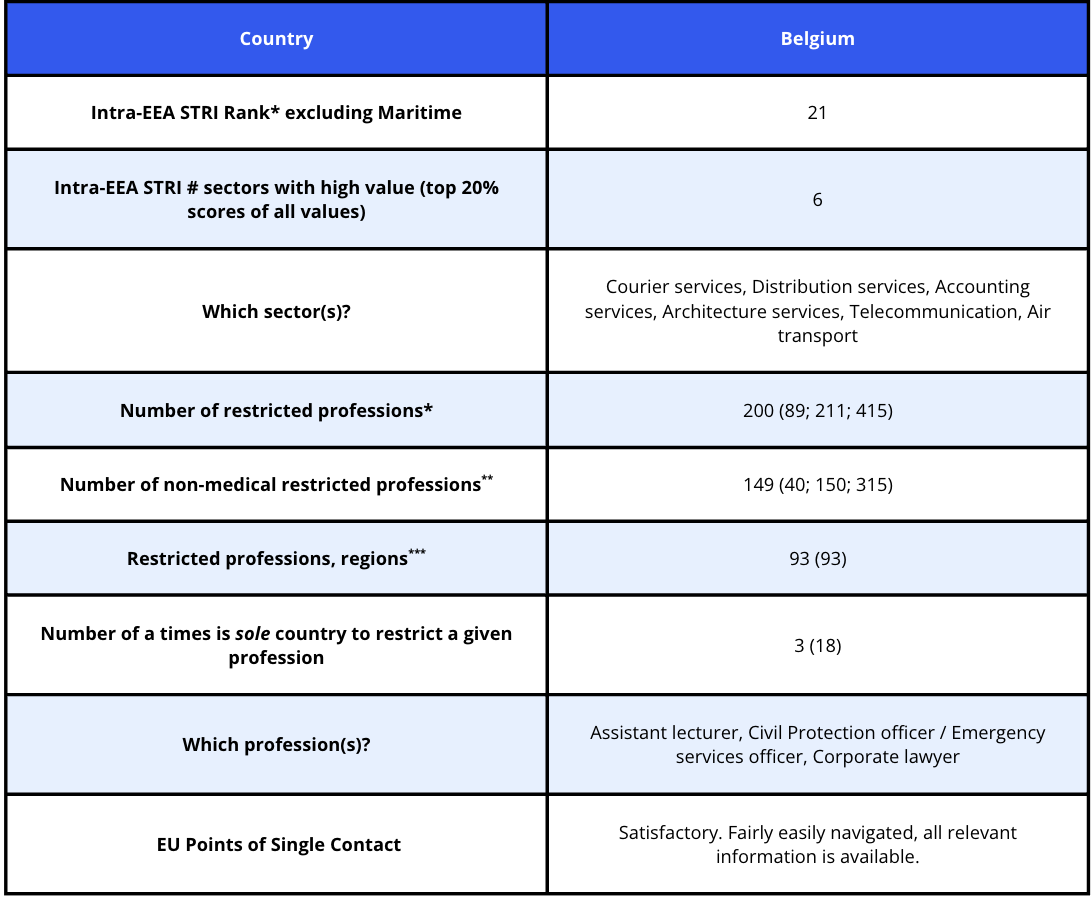
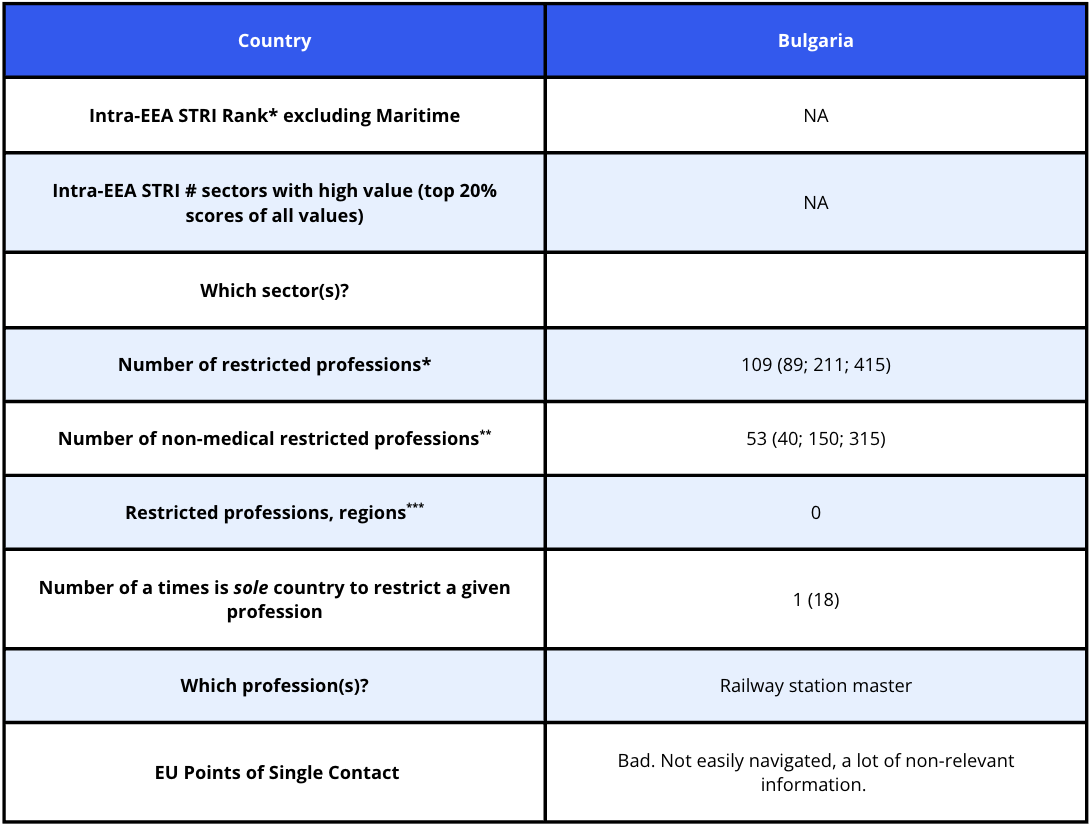
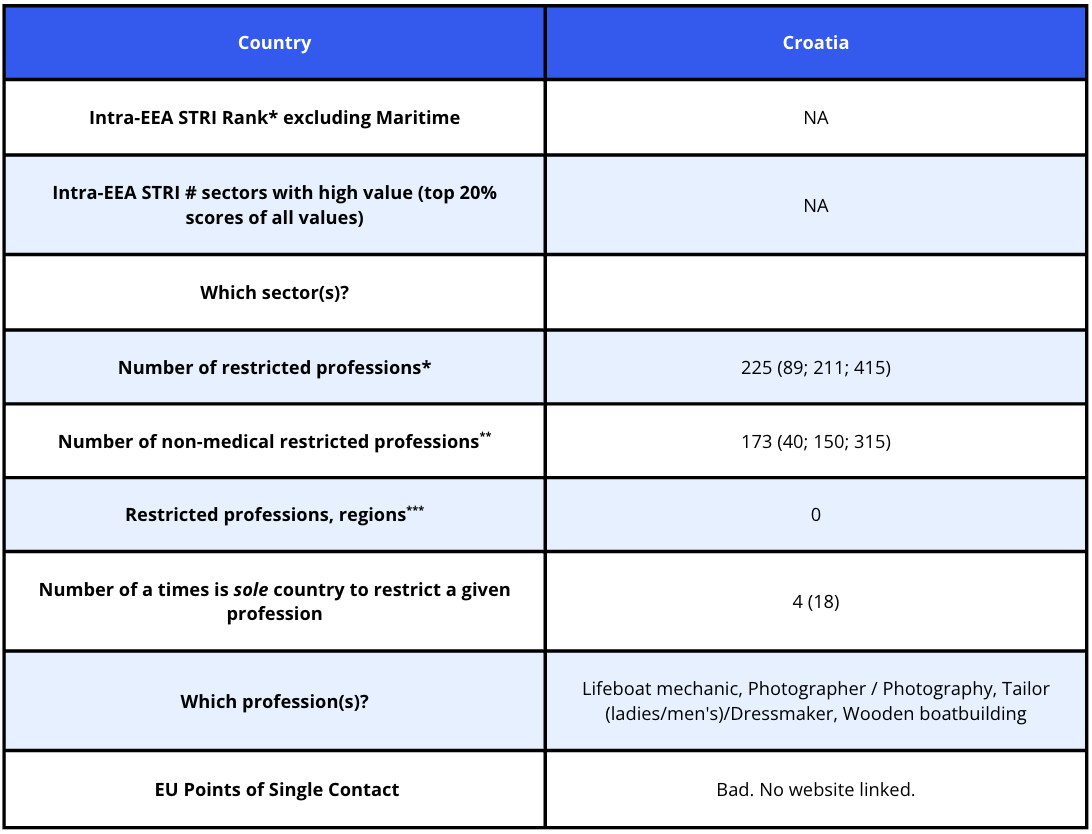
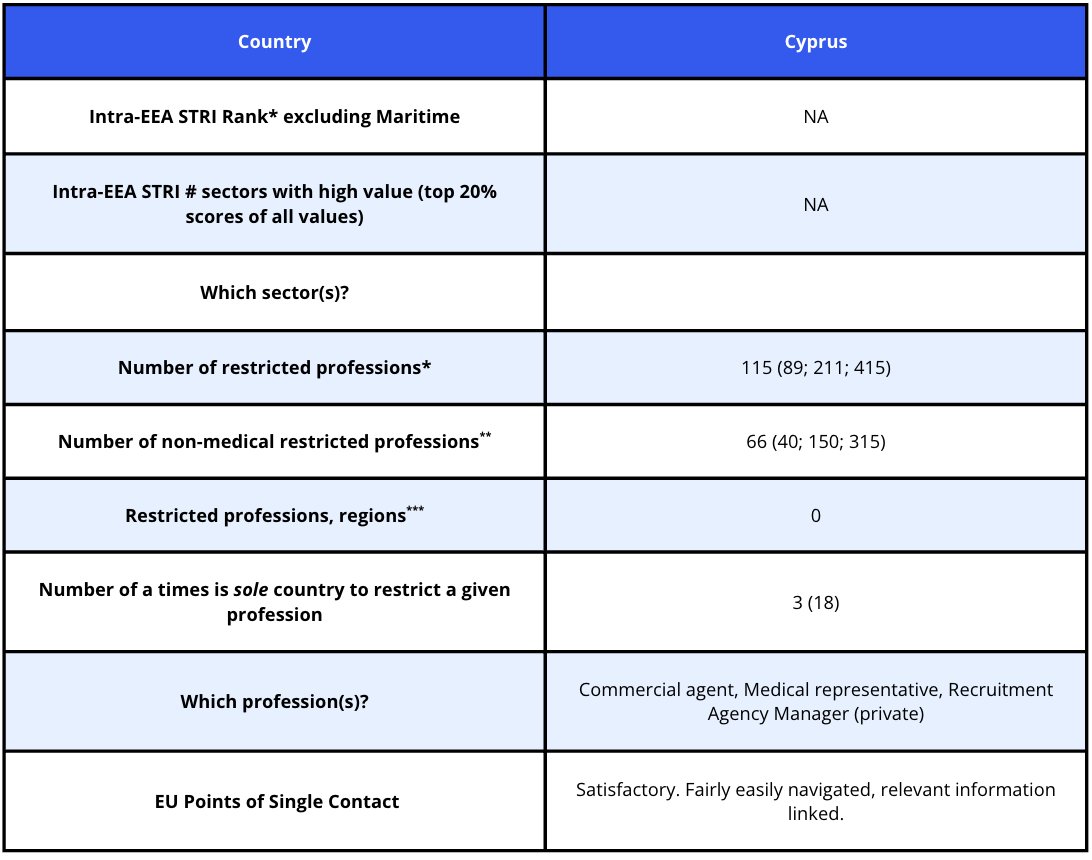
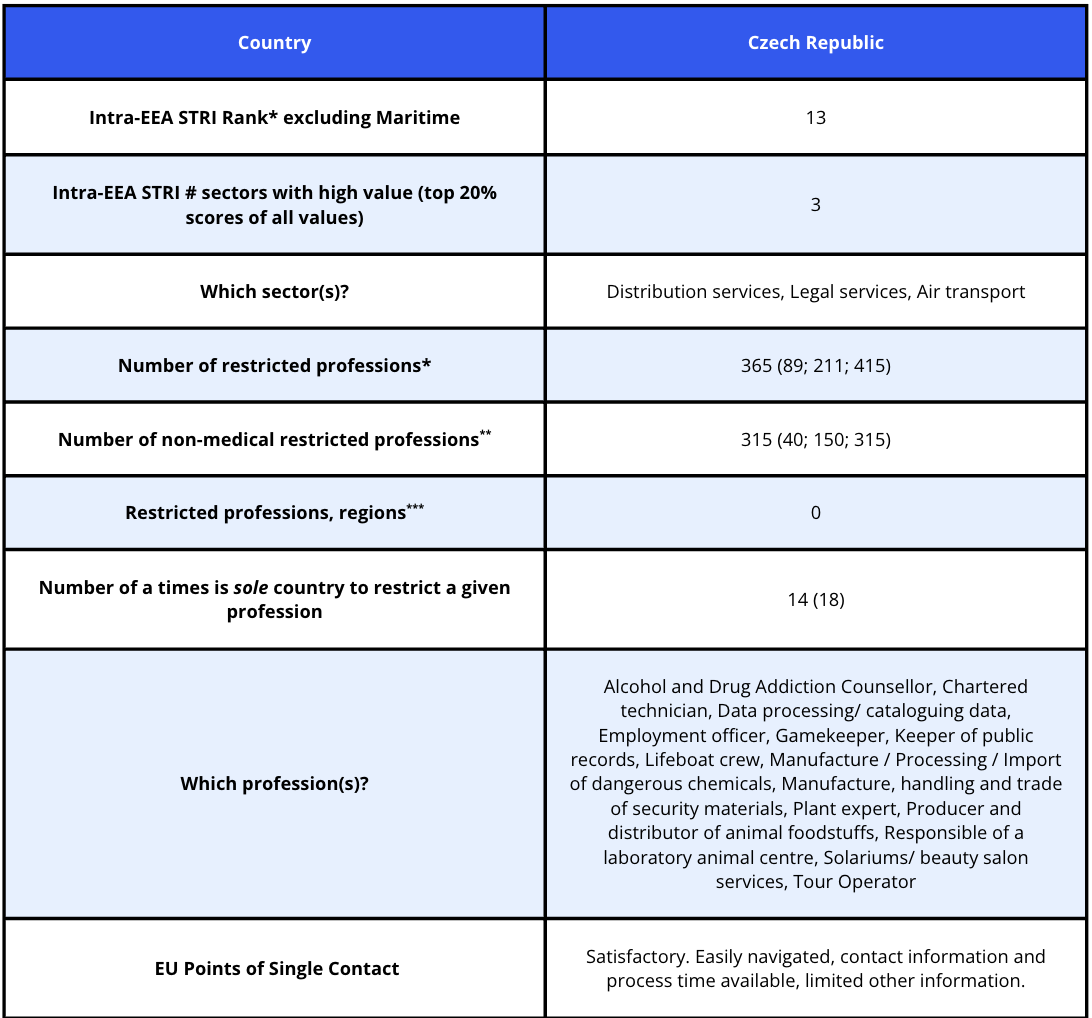
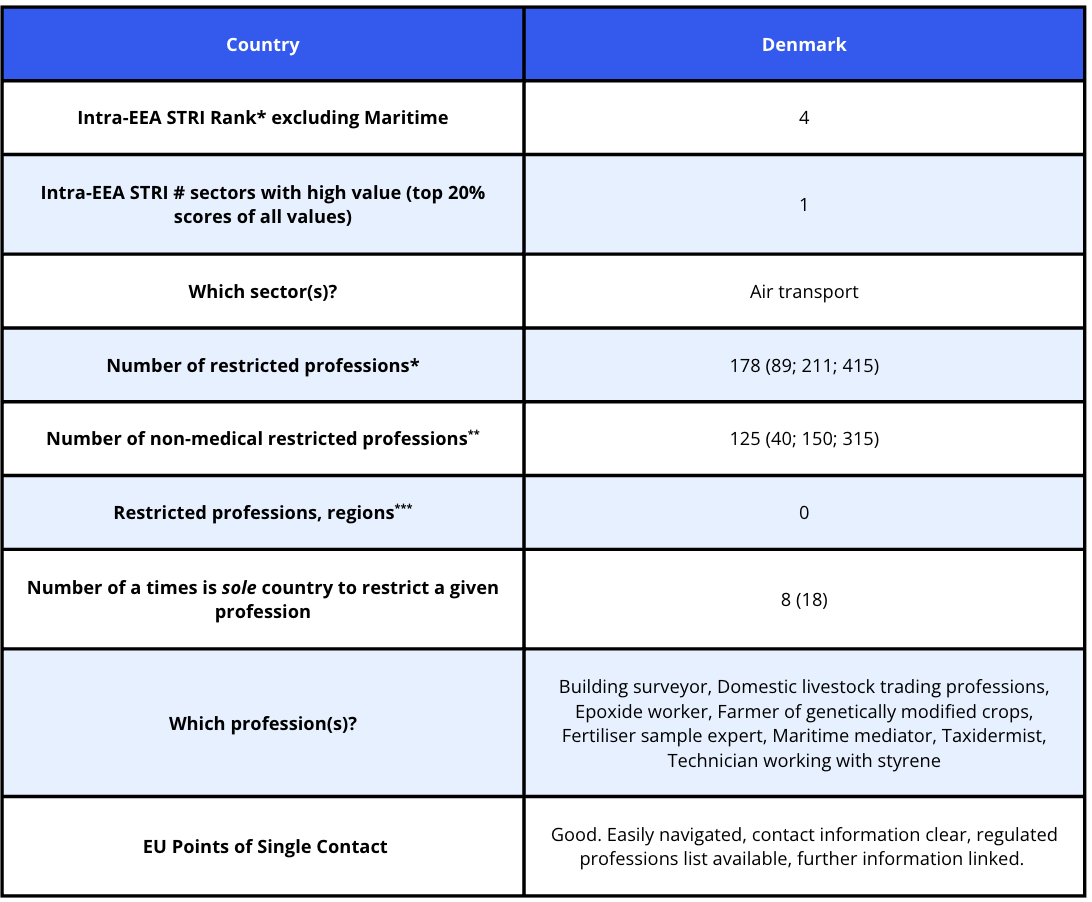
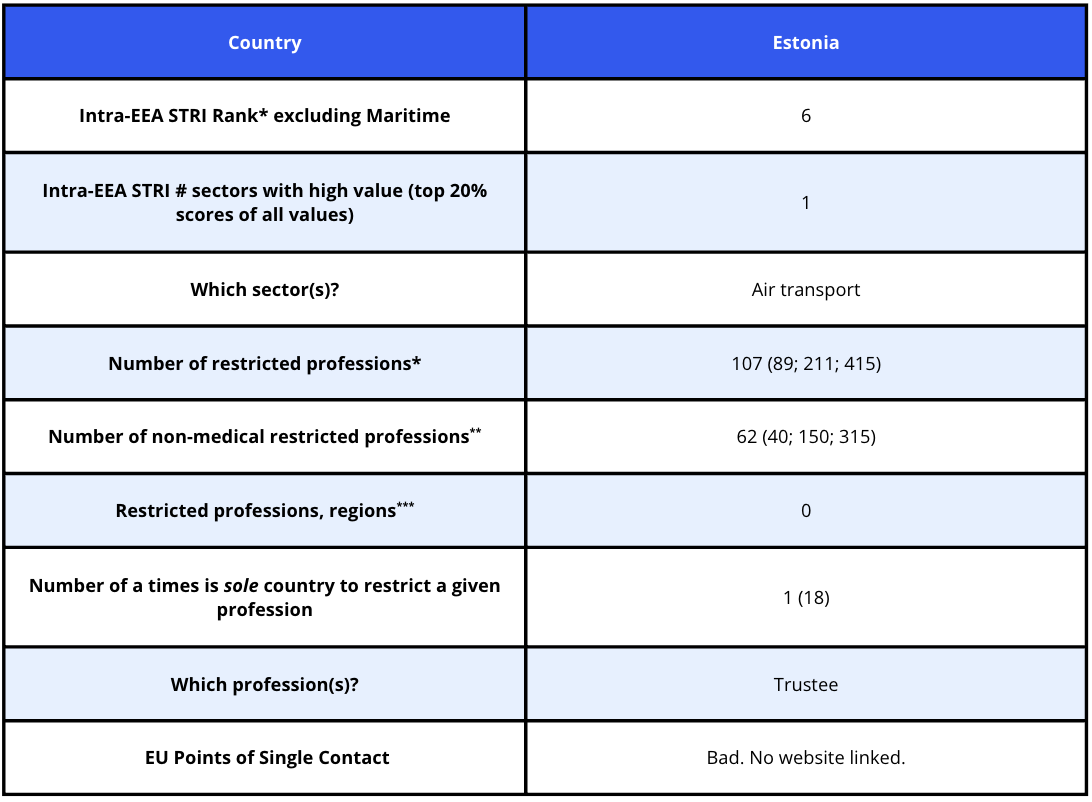
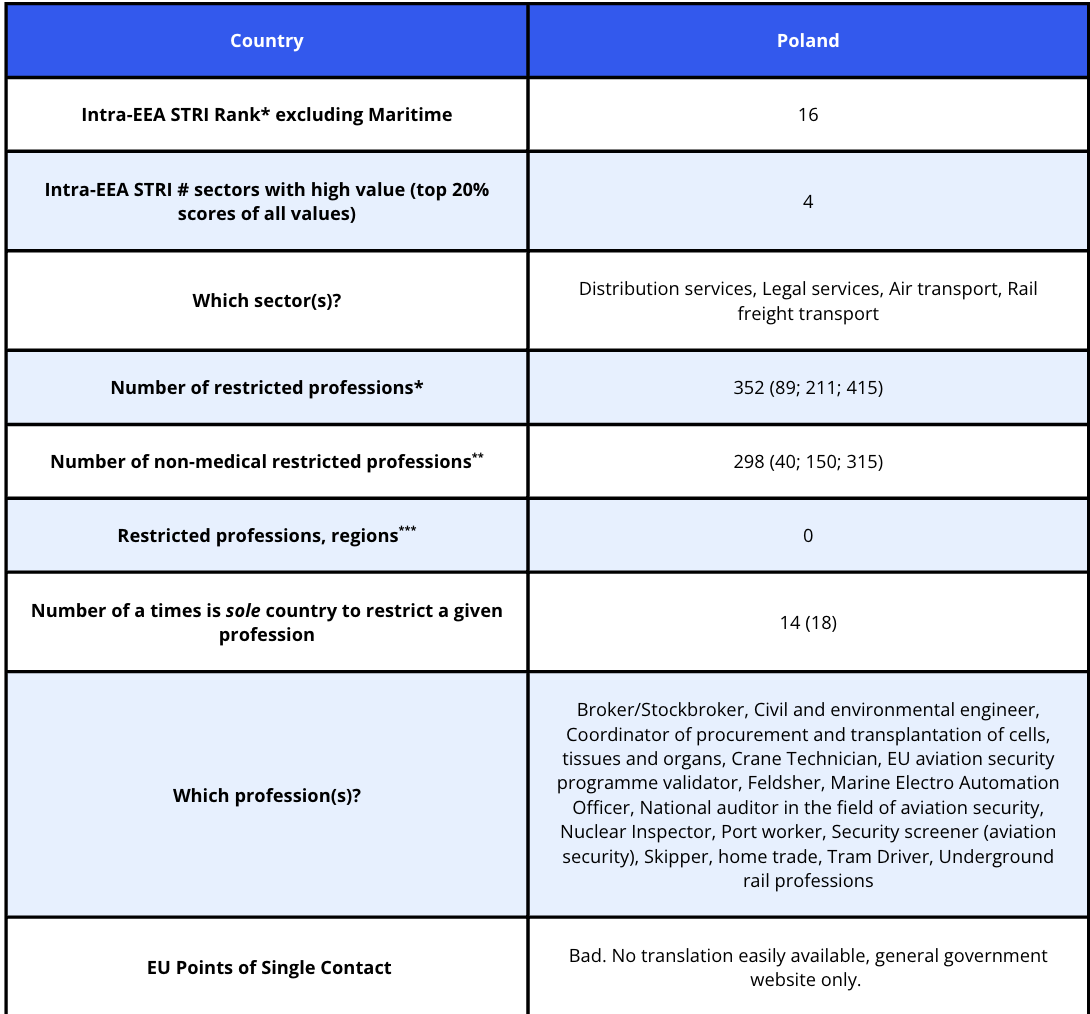
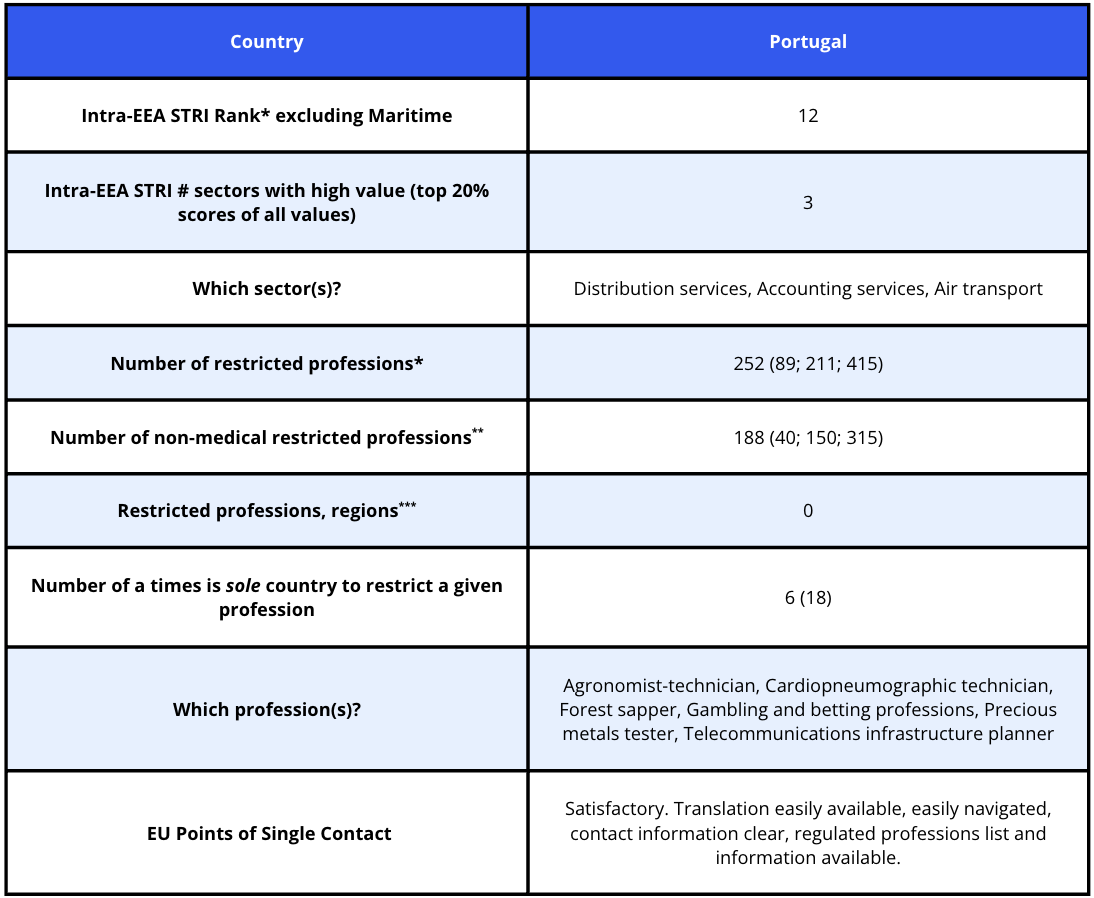
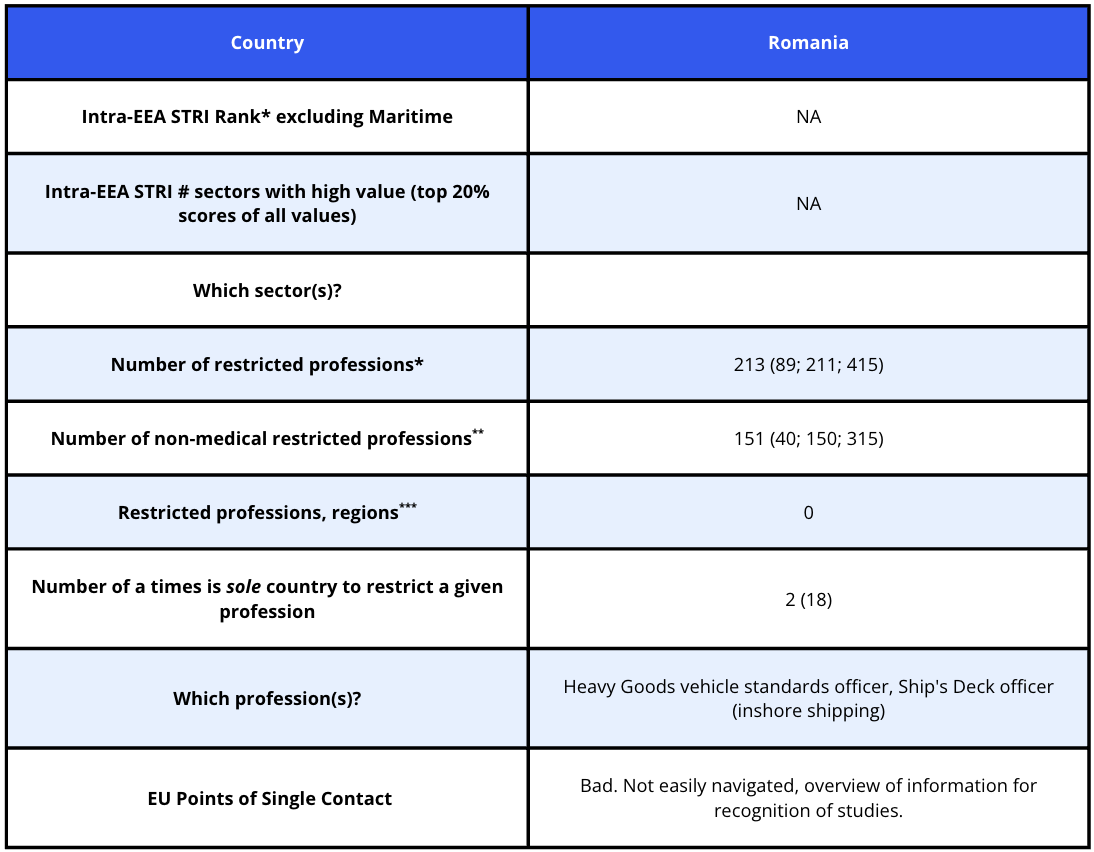
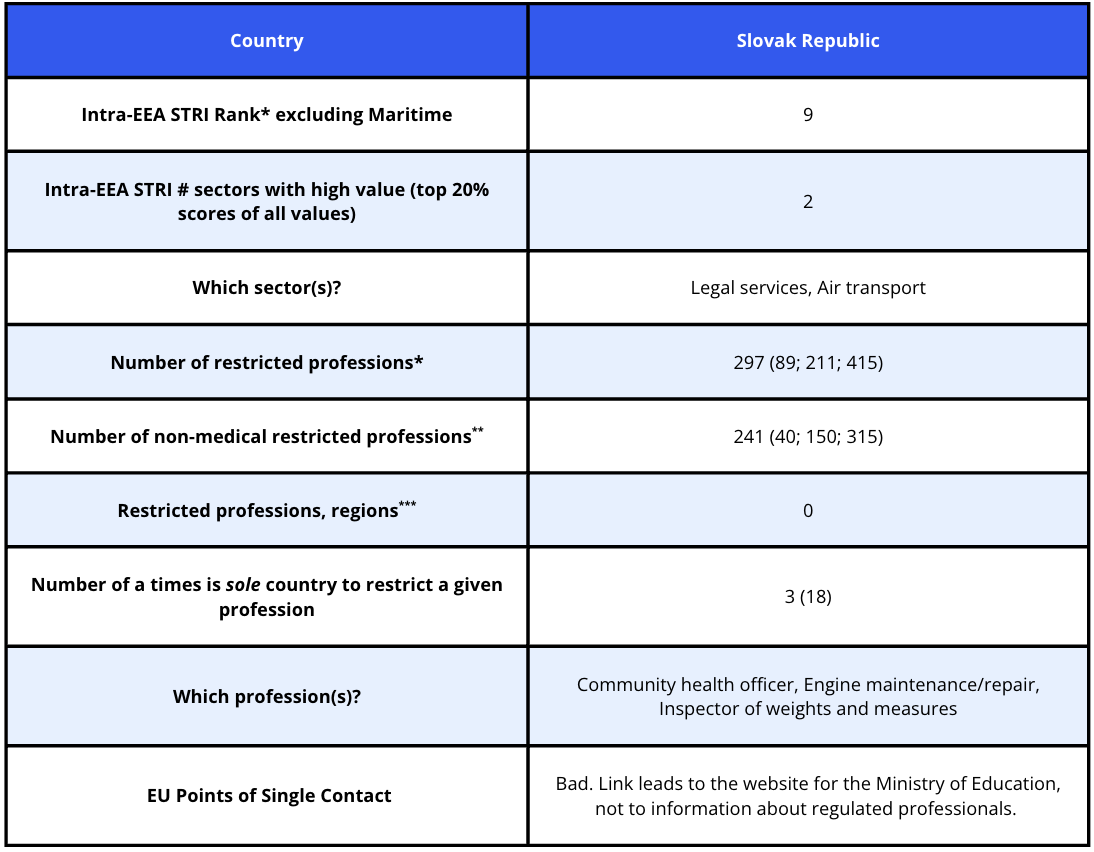
*In parenthesis, minimum, mean, and maximum value for the number of restricted professions for EU-27.
**In parenthesis, minimum, mean, and maximum value for number of non-medical restricted professions for EU-27.
***In parenthesis, the maximum number of regulated professions. 6/27 EU countries have regional differences in restricted professions (Belgium, Finland, Austria, Spain, Germany, and Italy). More than ¾ of EU countries have no regional differences in restricted professions.
Austria
Belgium
Bulgaria
Croatia
Cyprus
Czech Republic
Denmark
Estonia
Finland
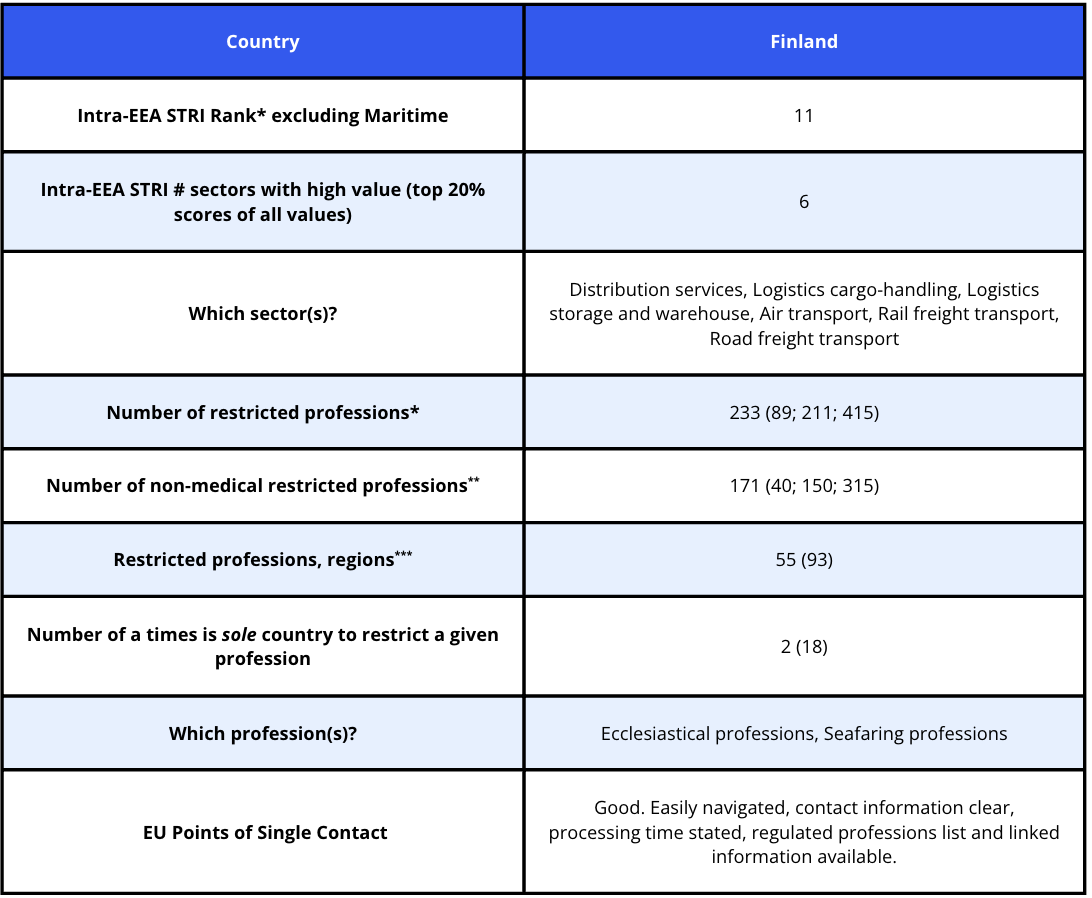
France
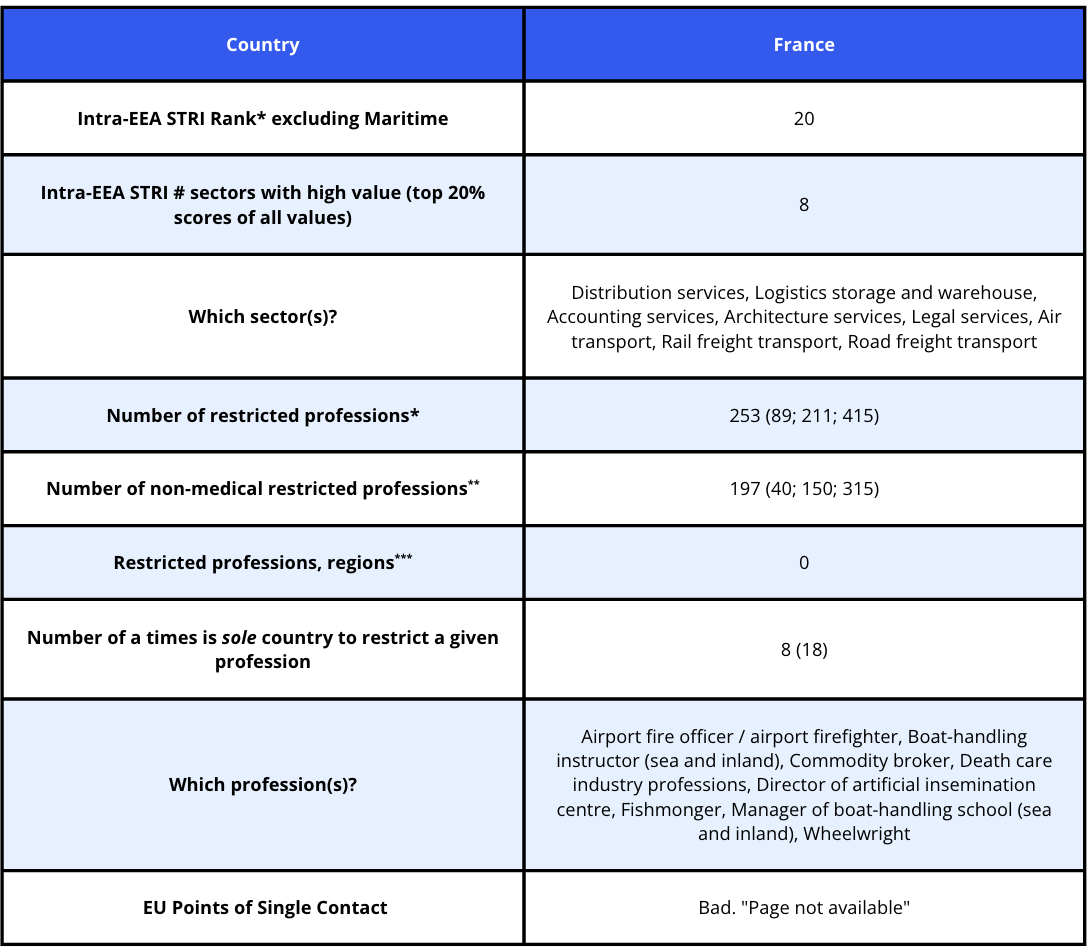
Germany
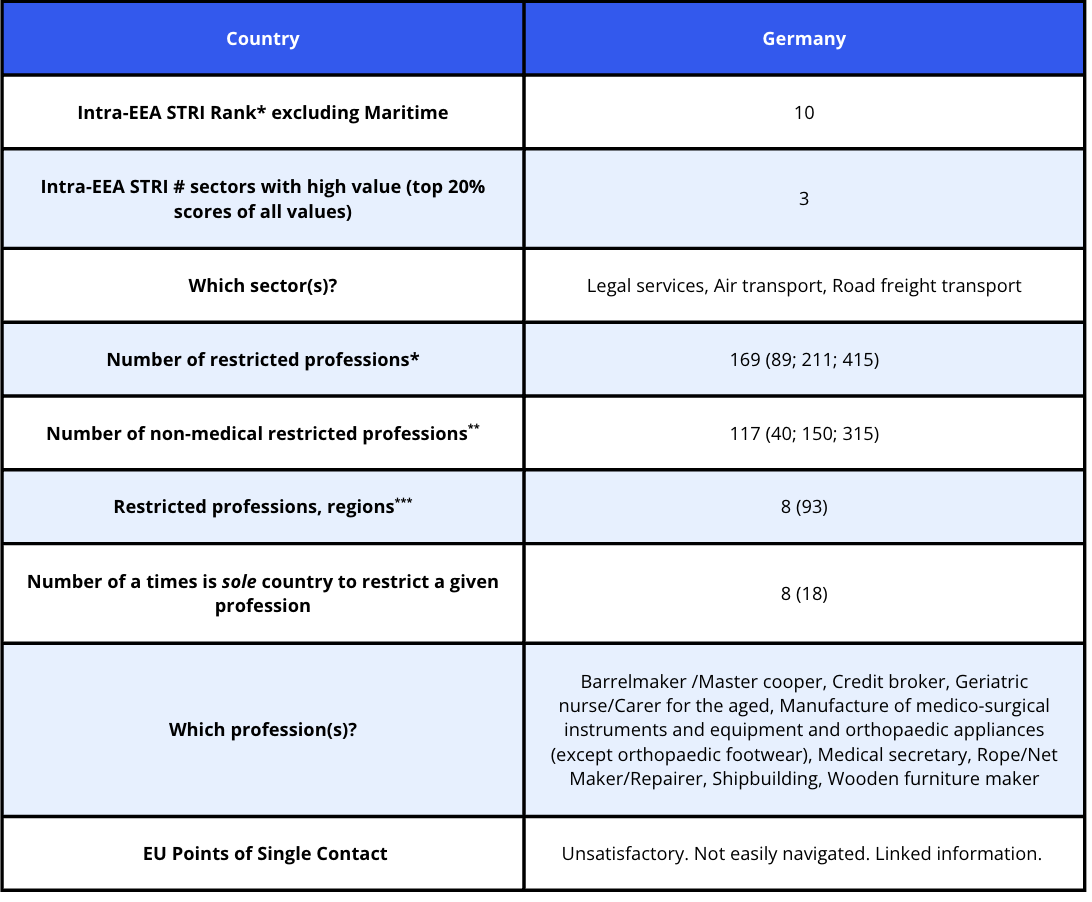
Greece
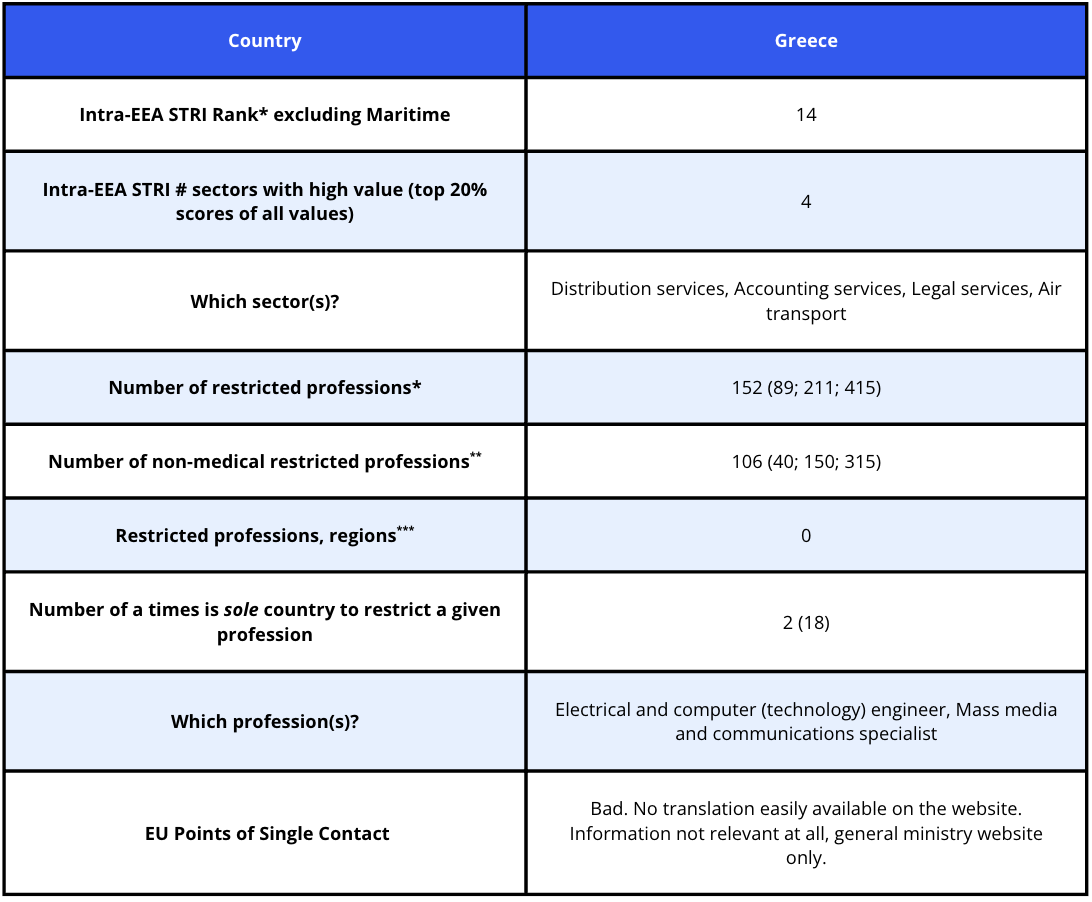
Hungary
Ireland
Italy
Latvia
Lithuania
Luxembourg
Malta
Netherlands
Poland
Portugal
Romania
Slovak Republic
Slovenia
Spain
Sweden
Adilbish, Oyun, Diego Cerdeiro, Romain Duval, Gee Hee Hong, Luca Mazzone, Lorenzo Rotunno, Hasan Toprak, and Maryam Vaziri (2025). “Europe’s Productivity Weakness – Firm-Level Roots and Remedies.” International Monetary Fund. WP/25/40.
Blix, Mårten (2023). “Wither on the vine – The unfulfilled EU Single Market for services.” Almega.
EU (2023). “Regulated professions database.” European Commission. Accessed: 1 March 2023.
OECD (2025). The OECD intra-EEA Service Trade Restrictiveness Index. Accessed: July 2025.
- Chairman of Almega FutureTech. Email: marten.blix@almega.se. I am grateful to Ratio for providing research resources. I would also like to thank Johannes Nathaniel for comments on an earlier draft and I would especially like to thank Emmie Sjöström for excellent research assistance.
- Draghi (2024) and Letta (2024).
- Draghi (2024, p. 5).
- Adilbish et al. (2025).
- This assessment was made on the 26 June 2025 (EU 2025a). See also the explanatory note to the Figure.
- The comparison is made between 1 March 2023 and 23 July 2025. For details about the 2023 vintage, see Blix (2023). A link to the EU regulated professions database is provided in the appendix (2025a). As regards regulated medical professions, there were 1,591 in 2023 and 1,627 in 2025, a slight increase.
- The increase with 19 regulated professions is explained by 17 additional medical professions, putting Sweden in the higher bracket, as well as 2 non-medical professions: Säkerhetschef för forsrännare (Safety Manager for Whitewater Rafters) and aktuariefunktion i antingen försäkringsföretag eller tjänstepensionsföretag (Actuarial Function in either Insurance Companies or Occupational Pension Companies).
- Not also that not all EU countries are members of the OECD: Bulgaria, Croatia, Cyprus, Malta, and Romania.
- Countries’ web pages are scored from 0–3 in the following five categories: English, navigation, relevance, clarity, processing time. The final quality assessment is based on a simple sum in each area, see Appendix A for details and for the links to web pages.